Lecture 25

E12 Linear Physical Systems Analysis

Prof. Emad Masroor
Prof. Will Johnson

April 20, 2026

Periodic Functions

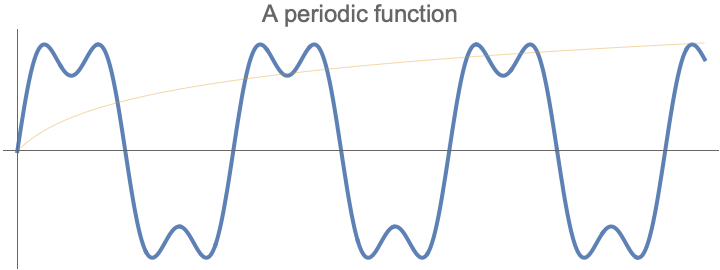
Some mathematical functions have the remarkable property of repeating themselves.
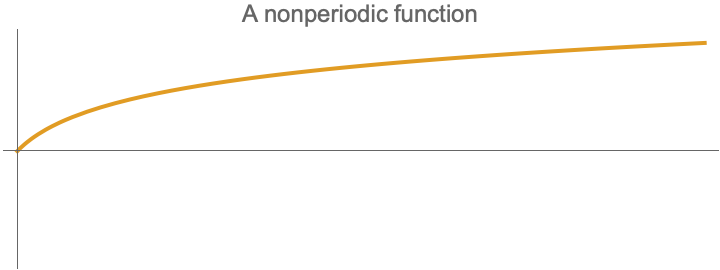
Defining what a periodic function is

The formal definition of a periodic function is:

  • A function \(f(t)\) is said to be periodic in \(t\) if, for some \(T\), \(f(t+nT) = f(t)\) for all integer \(n\).
  • If this is so, the number \(T\) is known as the period of the function \(f\).
  • We can describe a periodic function using one of three terms:
    • Its period \(T\)
    • Its frequency \(f = 1/T\)
    • Its angular frequency \(\omega = 2 \pi f = 2 \pi / T\)
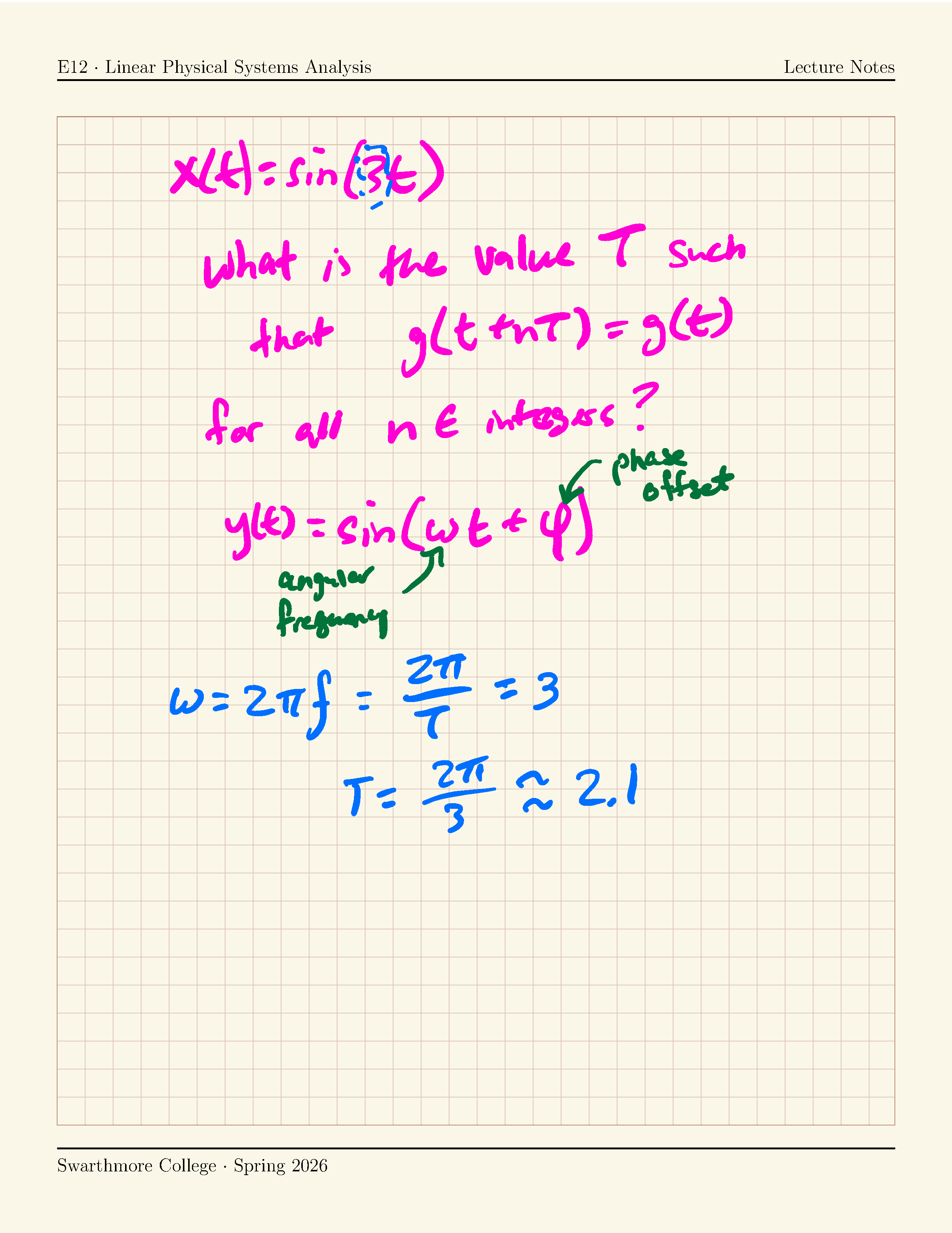
  • As an example, \(g(t) = \sin 3 t\) is a periodic function because we can find a value of \(T\) that will make the equation \(g(t) = g(t + n T)\) true for all \(T\).
    • Task: what is this special value of \(T\)?
  • As another example, \(g(t) = \log (t+1)\) is a nonperiodic function because we cannot find any value of \(T\) that will make the equation \(g(t) = g(t + n T)\) true for all \(T\).

Periodic functions made up of multiple sines and cosines.
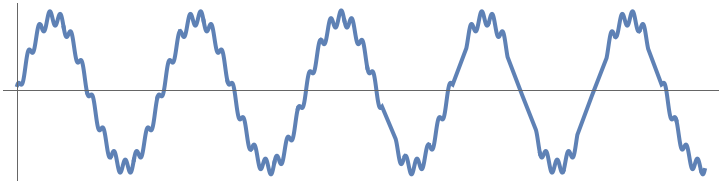
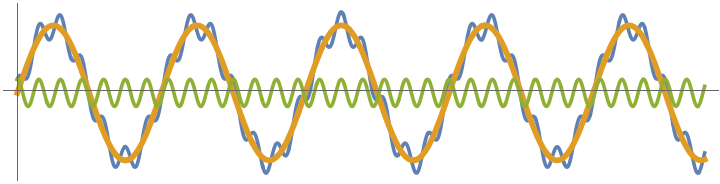
  • Sometimes, a function will ‘contain’ two very different frequencies.
  • Often, very high frequencies contribute to the “noise” in a single.
  • In this case, we have two functions: \[\sin 3 t + 0.2 \cos 20 t\]

The Fourier theorem (illustration)

Any periodic function can be represented as the sum of sines and cosines.
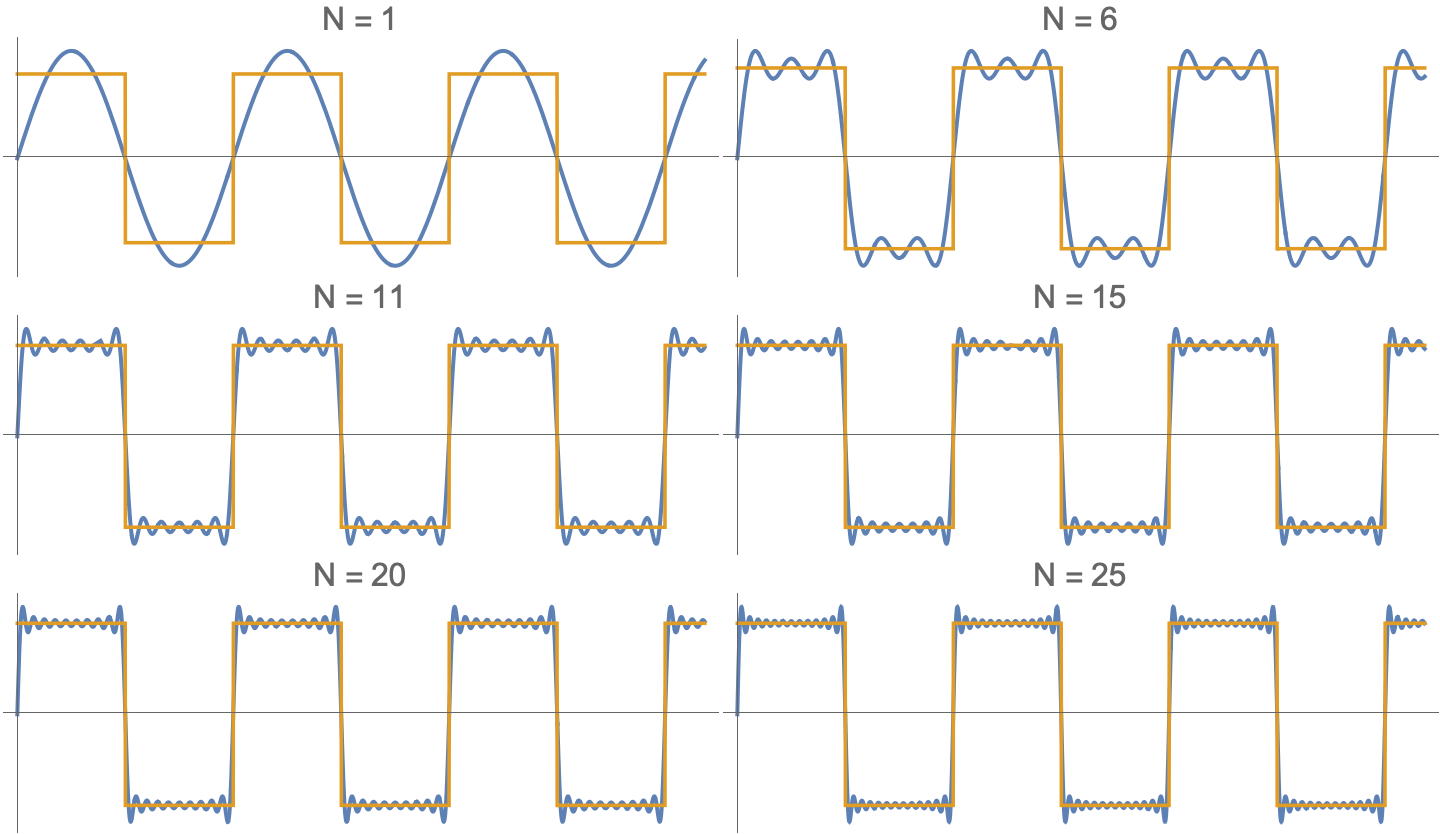
Mathematical Statement of the Fourier Theorem

A periodic function \(x(t)\) with period \(P\) is equal to the convergent infinite series

\[ \begin{aligned} x(t) &= a_0 + \sum_{n=1}^{\infty} \left( a_n \cos \left( \frac{2 \pi n t}{P} \right) + b_n \sin \left( \frac{2 \pi n t}{P} \right) \right) \\ x(t) &\approx a_0 + \sum_{n=1}^{N} \left( a_n \cos \left( \frac{2 \pi n t}{P} \right) + b_n \sin \left( \frac{2 \pi n t}{P} \right) \right) \end{aligned} \]

for \(a_n\), \(b_n\) given by the Euler Formulas:

\[ \begin{aligned} a_0 &= \frac{1}{P} \int_{-P/2}^{+P/2} x(t) dt \\ a_n &= \frac{2}{P} \int_{-P/2}^{+P/2} x(t) \cos \left( \frac{2 \pi n t}{P} \right) dt \quad n > 0\\ b_n &= \frac{2}{P} \int_{-P/2}^{+P/2} x(t) \sin \left( \frac{2 \pi n t}{P} \right) dt \quad n > 0\\ \end{aligned} \]

Why do we care

That any periodic function can be written as the sum of sines and cosines?
Computing the Fourier Series for small \(N\)

\[x(t) \approx a_0 + \sum_{n=1}^{N} \left( a_n \cos \left( \frac{2 \pi n t}{P} \right) + b_n \sin \left( \frac{2 \pi n t}{P} \right) \right)\]

  • If a truly infinite number of terms are added up, i.e., if \(N = \infty\) we have an exact equality between the left and right hand sides.
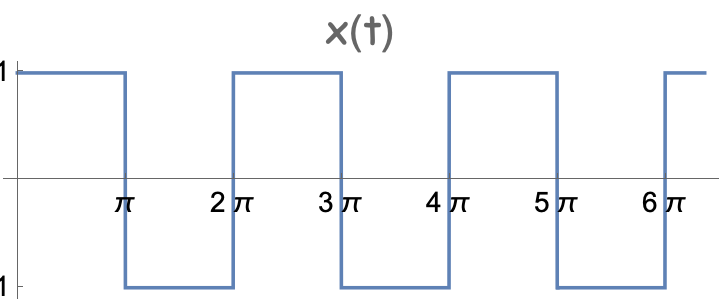
  • What happens when \(N\) is finite? Let’s examine the case when \(N=5\)
  • Let \(x(t)\) be given by the following function
Computing the coefficients

\[x(t) \approx a_0 + \sum_{n=1}^{N} \left( a_n \cos \left( \frac{2 \pi n t}{P} \right) + b_n \sin \left( \frac{2 \pi n t}{P} \right) \right)\]

First, we compute the terms \(a_n\) and \(b_n\) for \(N=5\). Using the Euler Formulas, we find the following values

Term Value Term Value
\(a_0\) 0
\(a_1\) 0 \(b_1\) 1.2732
\(a_2\) 0 \(b_2\) 0
\(a_3\) 0 \(b_3\) 0.4244
\(a_4\) 0 \(b_4\) 0
\(a_5\) 0 \(b_5\) 0.2546

The Fourier Theorem tells us that

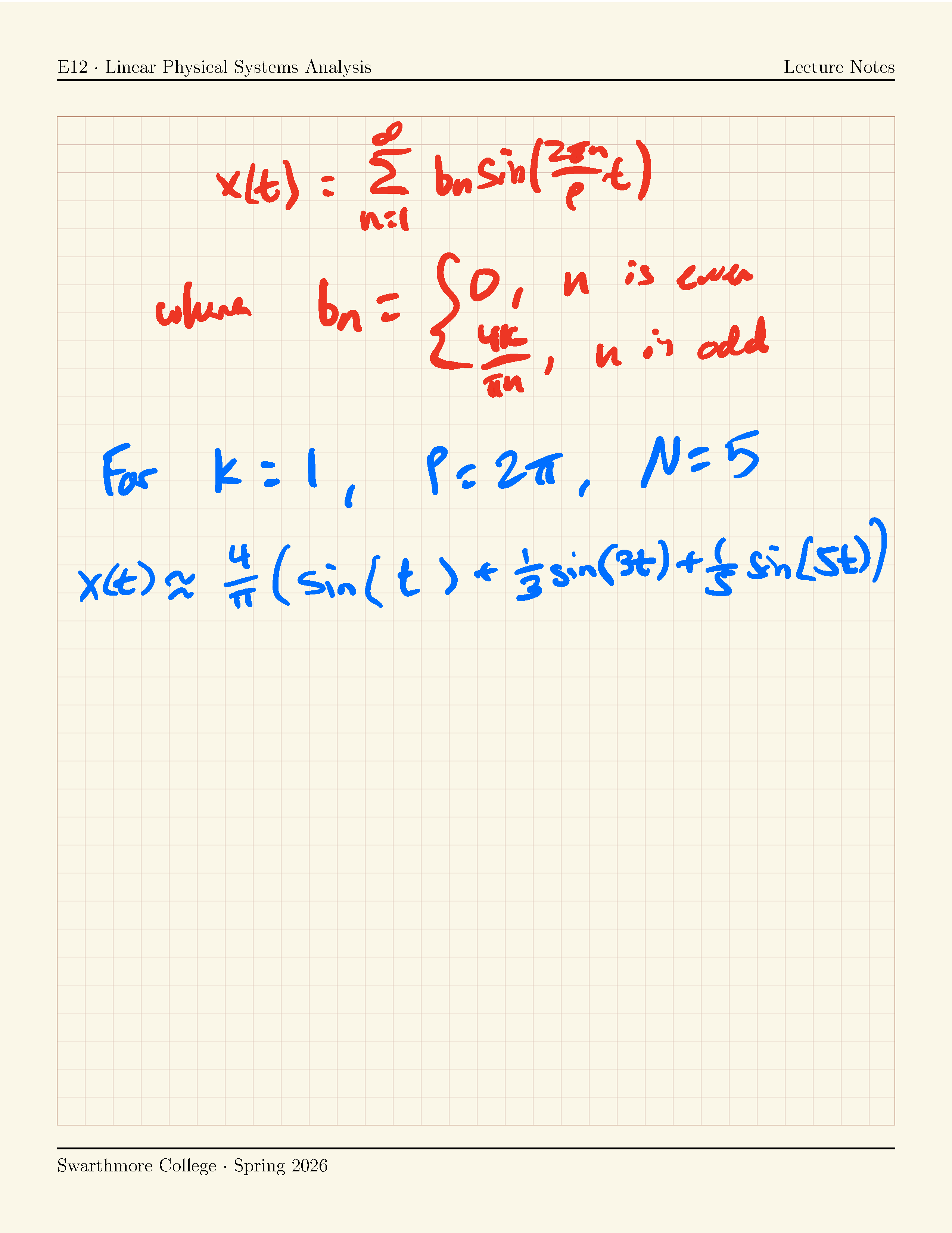
\[x(t) \approx 1.2732 \sin t + 0.4244 \sin 3t + 0.2546 \sin 5t\]

Visualizing the terms
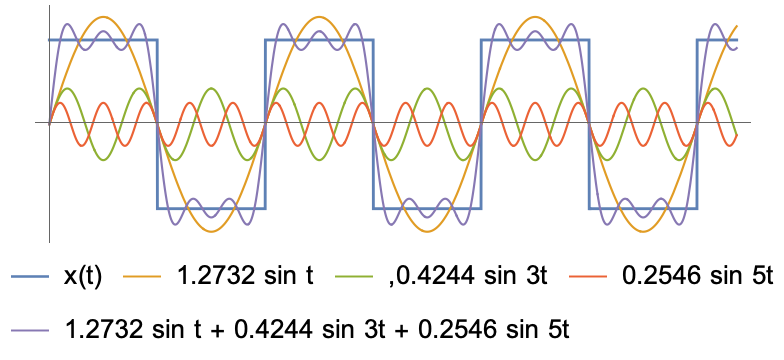
  • Each individual term does not resemble \(x(t)\)
  • But their cumulative sum does.
  • The terms are simply sine functions with different frequencies.
  • The magnitude of each term’s contribution — i.e., the amplitude of each constituent sinusoid — is given by the Euler formulas.

Harmonics and the Fundamental Frequency

  • A function with a period of 5 seconds repeats itself every 5 seconds.
  • It also repeats itself every \(2 \times 5\) seconds, every \(3 \times 5\) seconds, every \(4 \times 5\) seconds, …
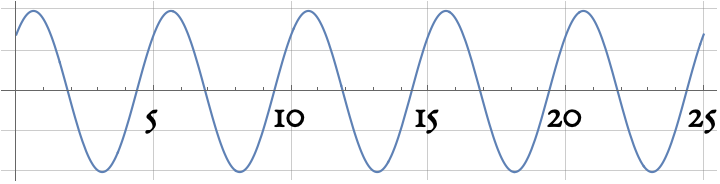
  • What is the period of this function?
  • If a function \(f(t)\) is periodic, we refer to its smallest period as its fundamental period
  • The frequency associated with the fundamental period, i.e., \(f = 1/T\), is known as the fundamental frequency
  • If a function \(x(t)\) has fundamental frequency \(f_0\), then its second harmonic is the frequency \(2f_0\), its third harmonic is the frequency \(3 f_0\), and so on.
  • Connection to musical notes on Wikipedia
Using Euler’s Formulas to derive Fourier Series approximations of a square wave ‘by hand’

or, it’s not that scary! Start with \(P=2\pi\)

\[ \begin{aligned} x(t) &\approx a_0 + \sum_{n=1}^{N} \left( a_n \cos \left( \frac{2 \pi n t}{P} \right) + b_n \sin \left( \frac{2 \pi n t}{P} \right) \right) \\ a_0 &= \frac{1}{P} \int_{-P/2}^{+P/2} x(t) dt \\ a_n &= \frac{2}{P} \int_{-P/2}^{+P/2} x(t) \cos \left( \frac{2 \pi n t}{P} \right) dt \quad n > 0\\ b_n &= \frac{2}{P} \int_{-P/2}^{+P/2} x(t) \sin \left( \frac{2 \pi n t}{P} \right) dt \quad n > 0\\ \end{aligned} \]

\[ \begin{aligned} x(t) &= \begin{cases} +1 & 0 < t < \pi \\ -1 & -\pi < t < 0 \end{cases} \\ x(t+2\pi \times n) &= x(t) \, \forall n \in \mathbb{N} \end{aligned} \]

Computing \(a_0\)

\(\displaystyle a_0 = \frac{1}{P} \int_{-P/2}^{+P/2} x(t) dt \quad\) where \(P=2\pi\)

Breaking up the integral into two parts, we get

\(\displaystyle = \frac{1}{2\pi} \left( \int_{-\pi}^{0} x(t) dt + \int_{0}^{+\pi} x(t) dt \right)\)

\(\displaystyle = \frac{1}{2\pi} \left( \int_{-\pi}^{0} (-k) dt + \int_{0}^{+\pi} (+k) dt \right)\)

\(\displaystyle = \frac{1}{2\pi} \left( \left[ -kt \right]_{-\pi}^{0} + \left[ kt \right]_{0}^{+\pi} \right)\)

\(\displaystyle = \frac{1}{2\pi} \left( \left[0-(-k\times (-\pi)) \right]+ (k\pi - 0) \right)\)

\(\displaystyle = \frac{1}{2\pi} \left( -k\pi + k\pi \right) = 0\)

  • We can also see that \(a_0\) must be zero because the area under the graph of \(x(t)\) is zero when computed from \(-\pi\) to \(+\pi\).

Computing \(a_n\)

\(\displaystyle a_n = \frac{2}{P} \int_{-P/2}^{+P/2} x(t) \cos \left( \frac{2 \pi n t}{P} \right) dt\quad\) where \(P = 2\pi\)

\(\displaystyle = \frac{2}{2\pi} \int_{-\pi}^{+\pi} x(t) \cos \left( \frac{2 \pi n t}{2\pi} \right) dt\) \(\displaystyle = \frac{1}{\pi} \int_{-\pi}^{+\pi} x(t) \cos \left(n t \right) dt\)

Breaking up the integral into two parts and dropping the \((t)\) notation

\(\displaystyle = \frac{1}{\pi} \left( \int_{-\pi}^{0} x \cos n t dt + \int_{0}^{+\pi} x \cos nt dt \right)\)

\(\displaystyle = \frac{1}{\pi} \left( \int_{-\pi}^{0} (-1) \cos n t dt + \int_{0}^{+\pi} (+1) \cos nt dt \right)\)

\(\displaystyle = \frac{1}{\pi} \left( \left[ - \frac{\sin n t}{n} \right]_{-\pi}^{0} + \left[ \frac{\sin n t}{n} \right]_{0}^{+\pi} \right)\)

\(\displaystyle = \frac{1}{n\pi} \left( \left[ - \sin 0 - (- \sin (-n \pi)) \right]+ \left[ \sin n \pi - \sin 0 \right] \right)\)

  • Note that \(sin x = 0\) at \(x=0\), \(x=\pi\), and indeed at \(x=n \pi\) for all integer \(n\). So we learn that \(a_n = 0\) for all \(n\).

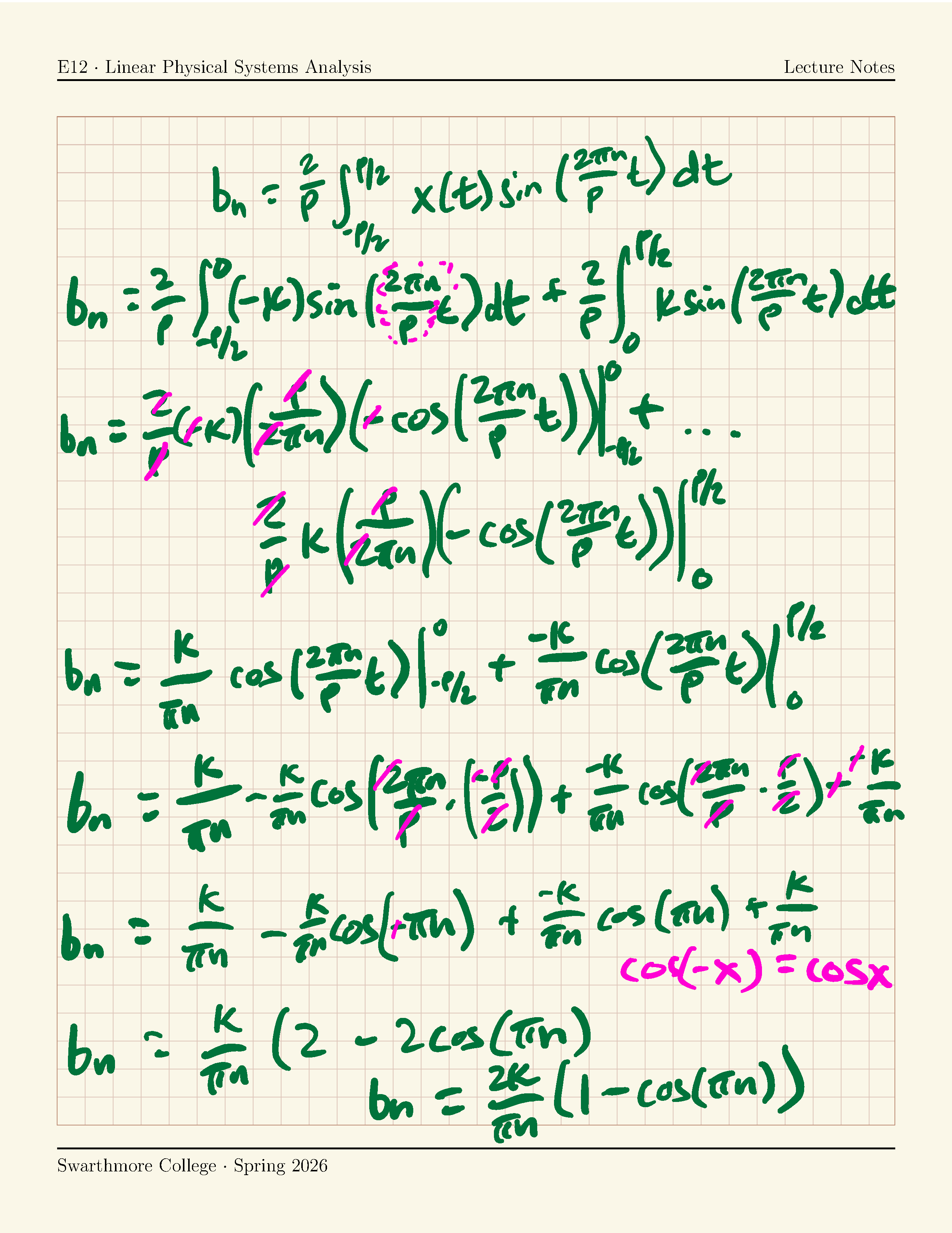
Computing \(b_n\)

\(\displaystyle b_n = \frac{2}{P} \int_{-P/2}^{+P/2} x(t) \sin \left( \frac{2 \pi n t}{P} \right) dt \quad\) where \(P=2\pi\)

\(\displaystyle = \frac{2}{2\pi} \int_{-\pi}^{+\pi} x(t) \sin \left( \frac{2 \pi n t}{2\pi} \right) dt\) \(\displaystyle = \frac{1}{\pi} \int_{-\pi}^{+\pi} x(t) \sin \left(n t \right) dt\)

Breaking up the integral into two parts and dropping the \((t)\) notation

\(\displaystyle = \frac{1}{\pi} \left( \int_{-\pi}^{0} x \sin n t dt + \int_{0}^{+\pi} x \sin nt dt \right)\)

\(\displaystyle = \frac{1}{\pi} \left( \int_{-\pi}^{0} (-1) \sin n t dt + \int_{0}^{+\pi} (+1) \sin nt dt \right)\)

\(\displaystyle = \frac{1}{\pi} \left( \left[ \frac{1}{n} \cos n t \right]_{-\pi}^{0} + \left[ -\frac{1}{n} \cos n t \right]_{0}^{+\pi} \right)\)

\(\displaystyle = \frac{1}{\pi} \left( \left[ \frac{\cos n t}{n} \right]_{-\pi}^{0} + \left[ - \frac{\cos n t}{n} \right]_{0}^{+\pi} \right)\)

\(\displaystyle = \frac{1}{n\pi} \left( \cos 0 - \cos(-n\pi) + (-\cos n\pi - (-\cos 0)) \right)\)

\(\displaystyle = \frac{1}{n\pi} \left( \cos 0 - \cos(-n\pi) - \cos n\pi +\cos 0) \right)\)

  • Using the fact that \(\cos 0 = 1\) and \(\cos (-x) = \cos x\),

\(\displaystyle \implies b_n= \frac{2}{n\pi} \left( 1 - \cos n\pi \right)\)

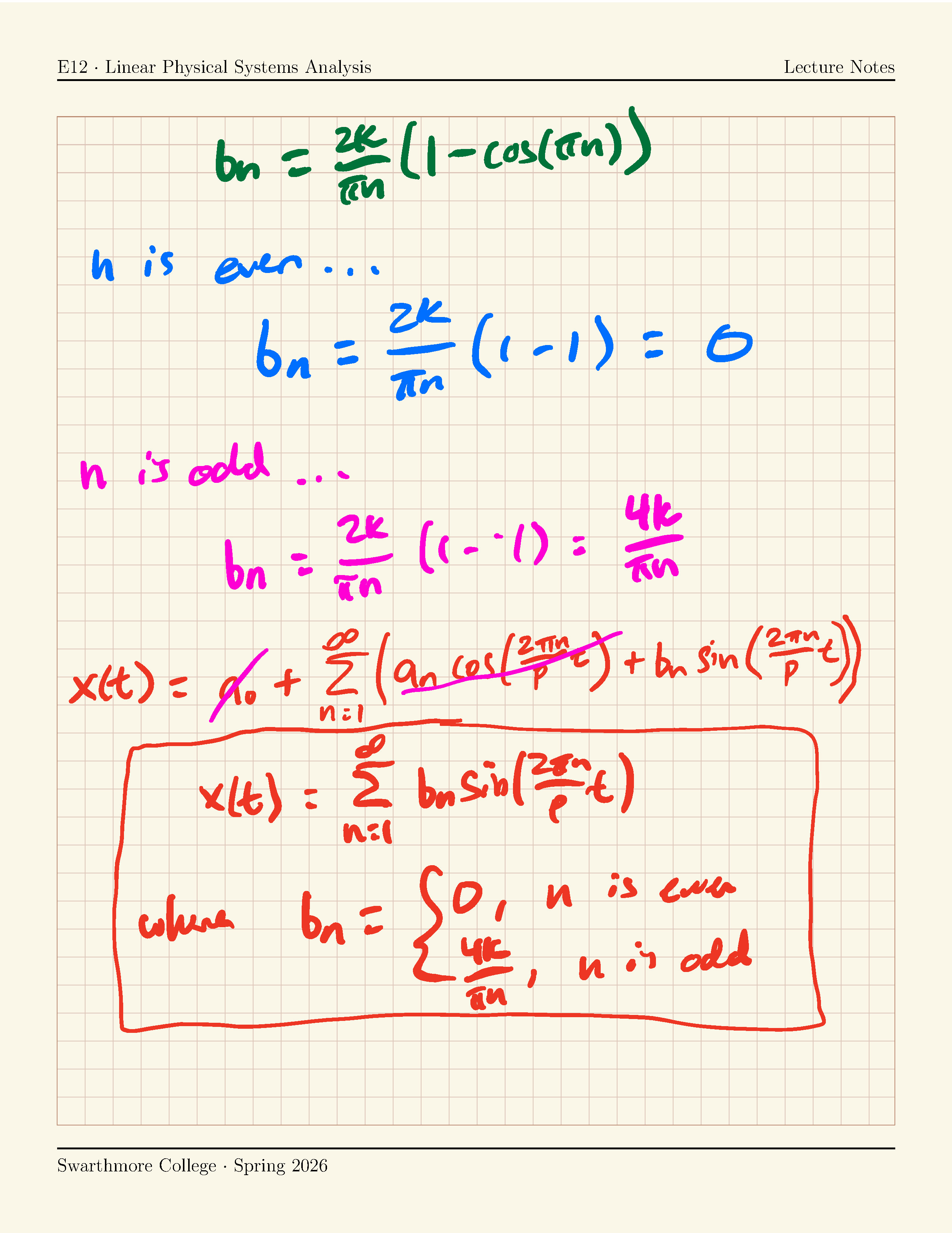
  • Recall that \(\cos n \pi = \begin{cases} -1 & n \text{ odd} \\ +1 & n \text{ even} \end{cases}\)

\(\displaystyle \implies b_n= \frac{2}{n\pi} \left( 1 - \cos n\pi \right) = \begin{cases} \displaystyle \frac{2}{n \pi} \left( 1 - (-1) \right) & n \text{ odd} \\ \displaystyle \frac{2}{n \pi} \left( 1 - (+1) \right) & n \text{ even} \end{cases}\)

\(\displaystyle \implies b_n= \begin{cases} \displaystyle \frac{4}{n \pi} & n \text{ odd} \\ 0 & n \text{ even} \end{cases}\)

The full Fourier Series for a square wave

The Fourier Series representation of the square wave with amplitude 1 and period \(2\pi\), i.e., of the function

\[ \begin{aligned} x(t) &= \begin{cases} +1 & 0 < t < \pi \\ -1 & -\pi < t < 0 \end{cases} \\ x(t+2\pi \times n) &= x(t) \, \forall n \in \mathbb{N} \end{aligned} \]

is therefore

\[x(t) = \sum_{n=1}^{\infty} \left( b_n \sin n t \right), \quad b_n = \begin{cases} \displaystyle \frac{4}{n \pi} & n \text{ odd} \\ 0 & n \text{ even} \end{cases} \tag{1}\]

i.e., \(x\) equals the infinite sum

\[x(t) = \frac{4}{\pi} \left( \frac{1}{1} \sin t + \frac{1}{3} \sin 3 t + \frac{1}{5} \sin 5t + ...\right)\]

where we use the term partial sum up to \(N\) to mean Equation 1 carried out up to \(n = N\).

Even and Odd Functions

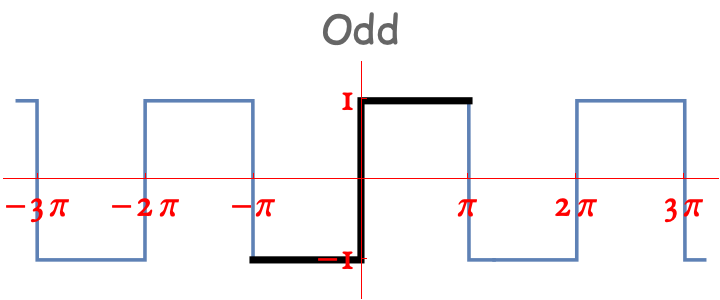
We notice that the Fourier Series for the function \(x(t)\) shown here contains only \(\sin\) terms and no \(\cos\) terms.
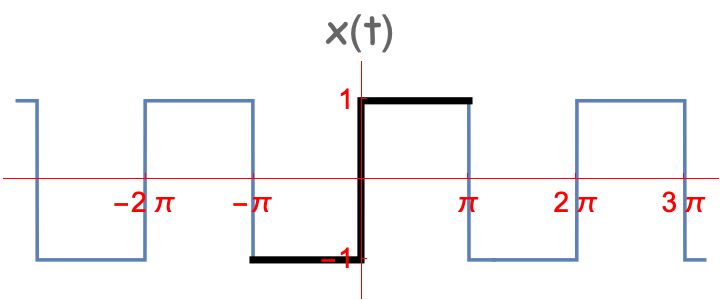
  • This is because \(x(t)\) is an odd function.

  • An odd function \(f(x)\) is a function for which \(\boxed{f(x) = - f(-x)}\) for all \(x\).

  • Conversely, an even function \(f(x)\) is a function for which \(\boxed{f(x) = f(-x)}\) for all \(x\).

  • Odd functions have Fourier Series that contain only \(\sin\) terms

  • Even functions have Fourier Series that contain only \(\cos\) terms

  • If a function is neither even nor odd, its Fourier Series contains both \(\sin\) and \(\cos\) terms.

Visualizing Even vs odd functionss
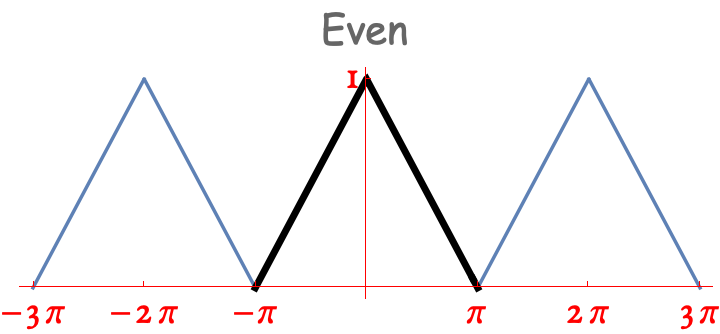
Calculating coefficients for another Fourier Series

Show that a mathematical description of the given triangle wave with fundamental period \(2\pi\) is

\[ x(t) = \begin{cases} \displaystyle \frac{t - \pi}{\pi} & -\pi < t < 0 \\ \displaystyle \frac{\pi- t}{\pi} & 0 < t < +\pi \end{cases} \]

Then, show by using piecewise integration of the Euler Formulas that

  • \(\displaystyle a_n =\frac{4}{n^2 \pi^2}\) for odd values of \(n>0\),
  • \(a_n = 0\) for even values of \(n\)
  • \(a_0 = 1/2\).

The infinite Fourier series for this function is

\[x(t) = \frac{4}{\pi^2} \left( \cos t + \frac{\cos 3t}{9} + \frac{\cos 5t}{25} + ...\right)\]

In-class notes
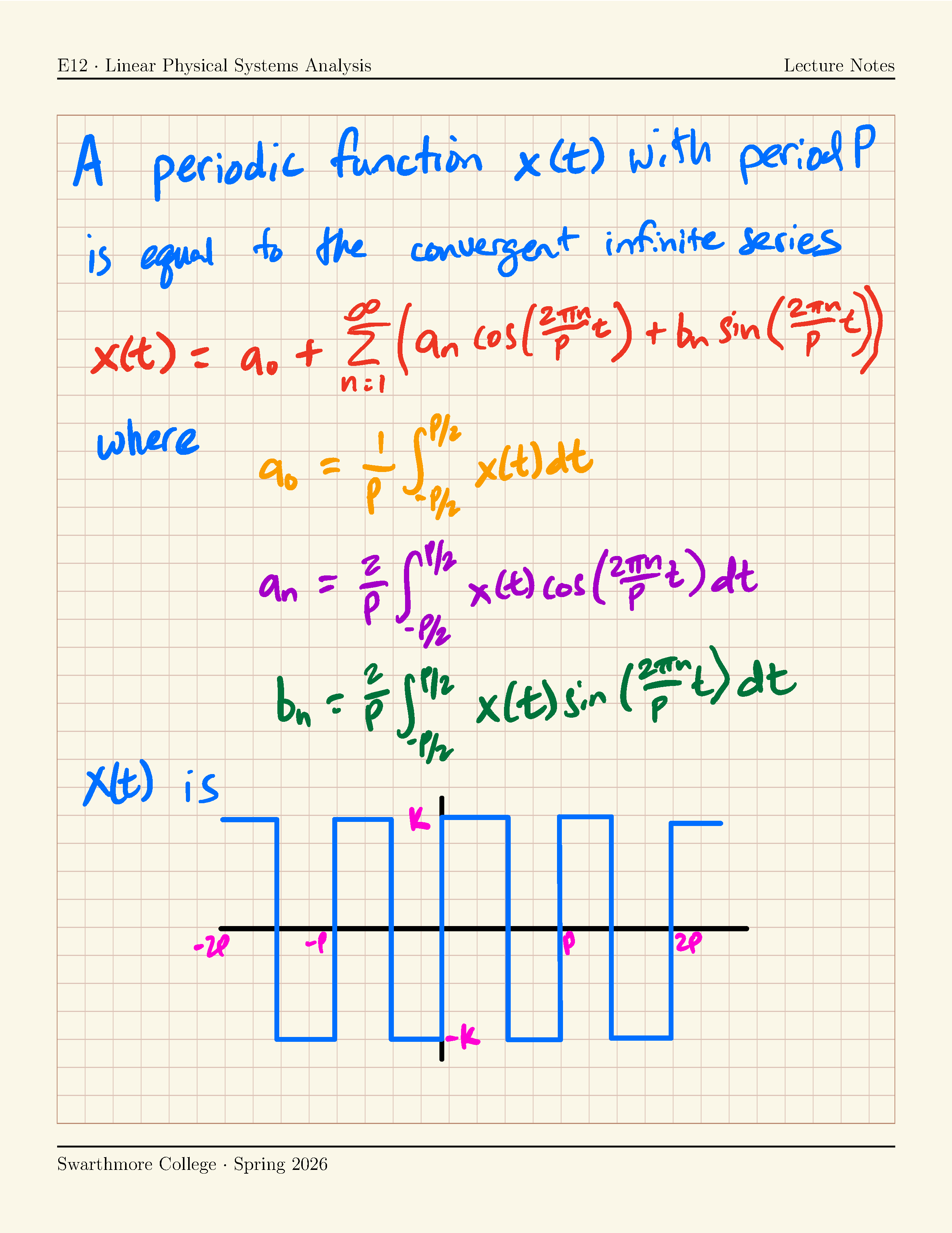
In-class notes
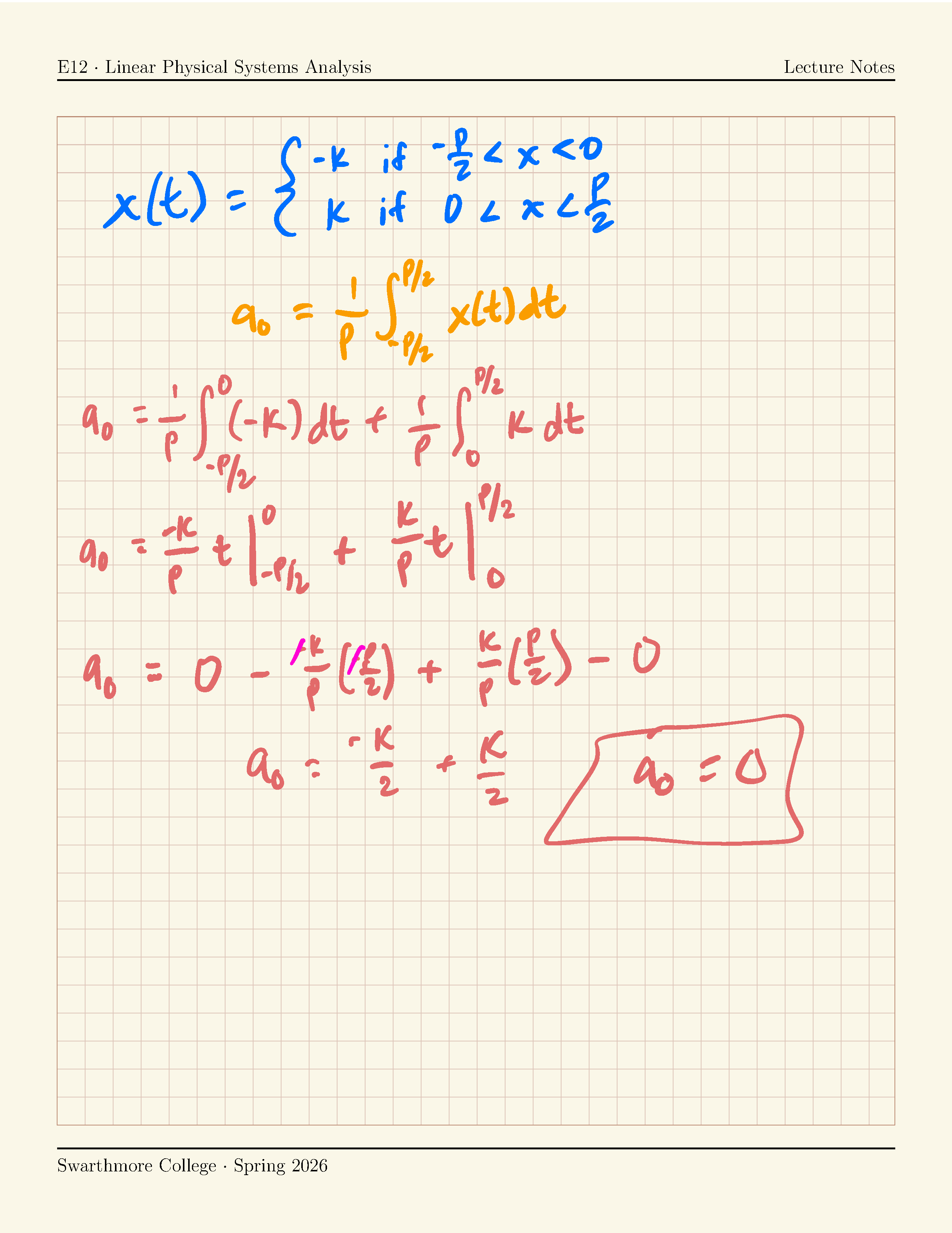
In-class notes
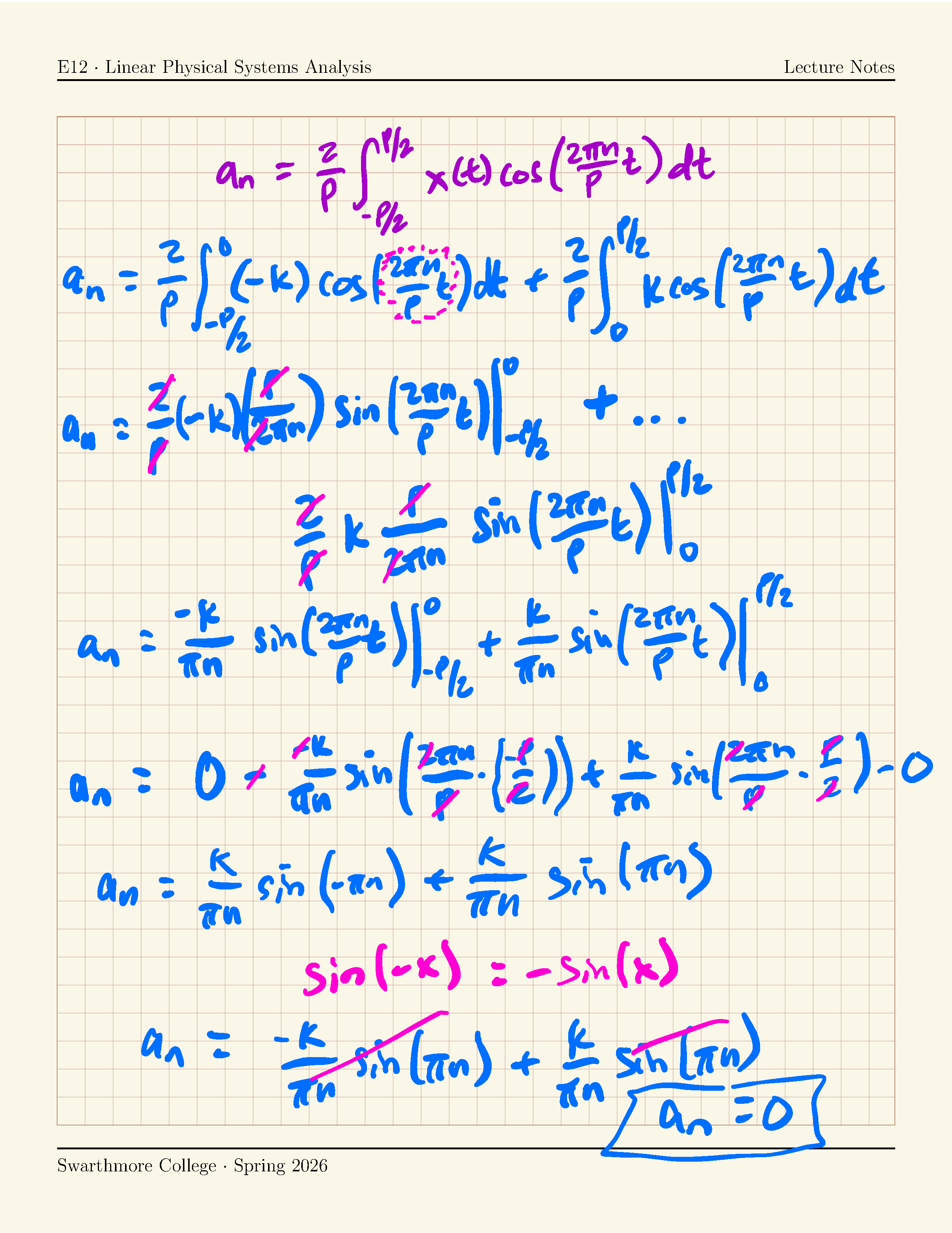
In-class notes
In-class notes
In-class notes
In-class notes