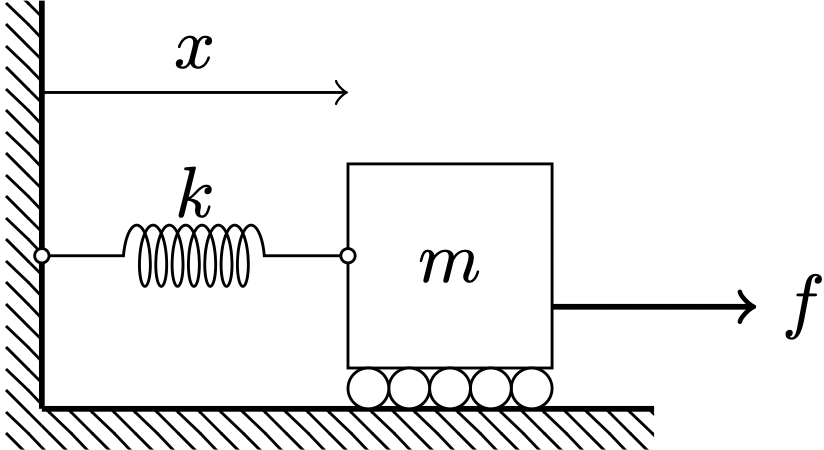
One choice of state variables is \(x\) and \(\dot{x}\), position and velocity. \[
\frac{d}{dt} \begin{bmatrix} x \\ \dot{x} \end{bmatrix} = \begin{bmatrix} \dot{x} \\ -(k/m)x \end{bmatrix} = \begin{bmatrix} 0 & 1 \\ -k/m & 0 \end{bmatrix} \begin{bmatrix} x \\ \dot{x} \end{bmatrix}
\]
Another choice of state variables is \(x\) and \(m \dot{x}\), position and momentum. What would the above equations be with these as the state variables instead?\[
\frac{d}{dt} \begin{bmatrix} x \\ m\dot{x} \end{bmatrix} = \begin{bmatrix} ? \\ ? \end{bmatrix} = \begin{bmatrix} ? & ? \\ ? & ? \end{bmatrix} \begin{bmatrix} x \\ m\dot{x}
\end{bmatrix}
\]
\[
\frac{d}{dt} \begin{bmatrix} x \\ m\dot{x} \end{bmatrix} = \begin{bmatrix} \dot{x} \\m \ddot{x} \end{bmatrix} = \begin{bmatrix} \dot{x} \\ - k x \end{bmatrix} = \begin{bmatrix} 0 & 1/m \\ -k & 0 \end{bmatrix} \begin{bmatrix} x \\ m\dot{x} \end{bmatrix}
\]
The rest length of a spring and state variables
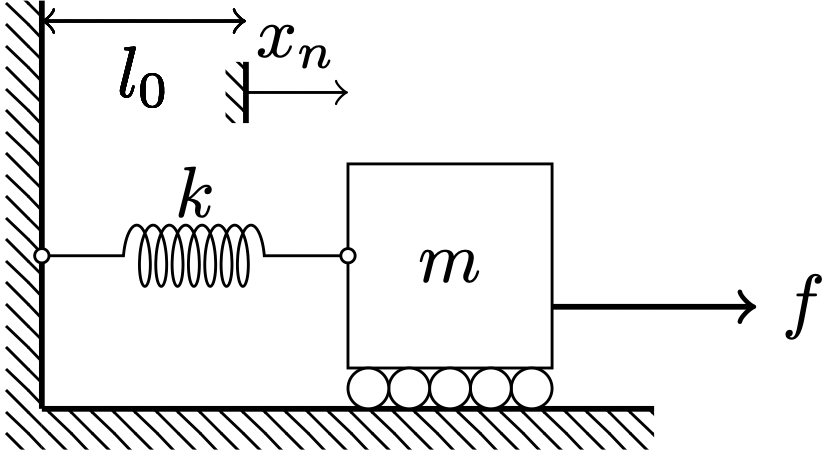
The rest length \(l_0\) of a spring is the length at which it exerts no force. It’s neither compressed nor extended.
Note: Our springs are always ‘bidirectional’:
if extended, they pull back;
if compressed, they push back.
when their length equals \(l_0\), they don’t push or pull
Measuring the length from the wall
Write down Newton’s 2nd Law for this mass (FBD)
\[m \ddot{x} = f - k (x-l_0)\]\[m \ddot{x} + kx = f + k l_0 \]Let’s say \(f=0\)
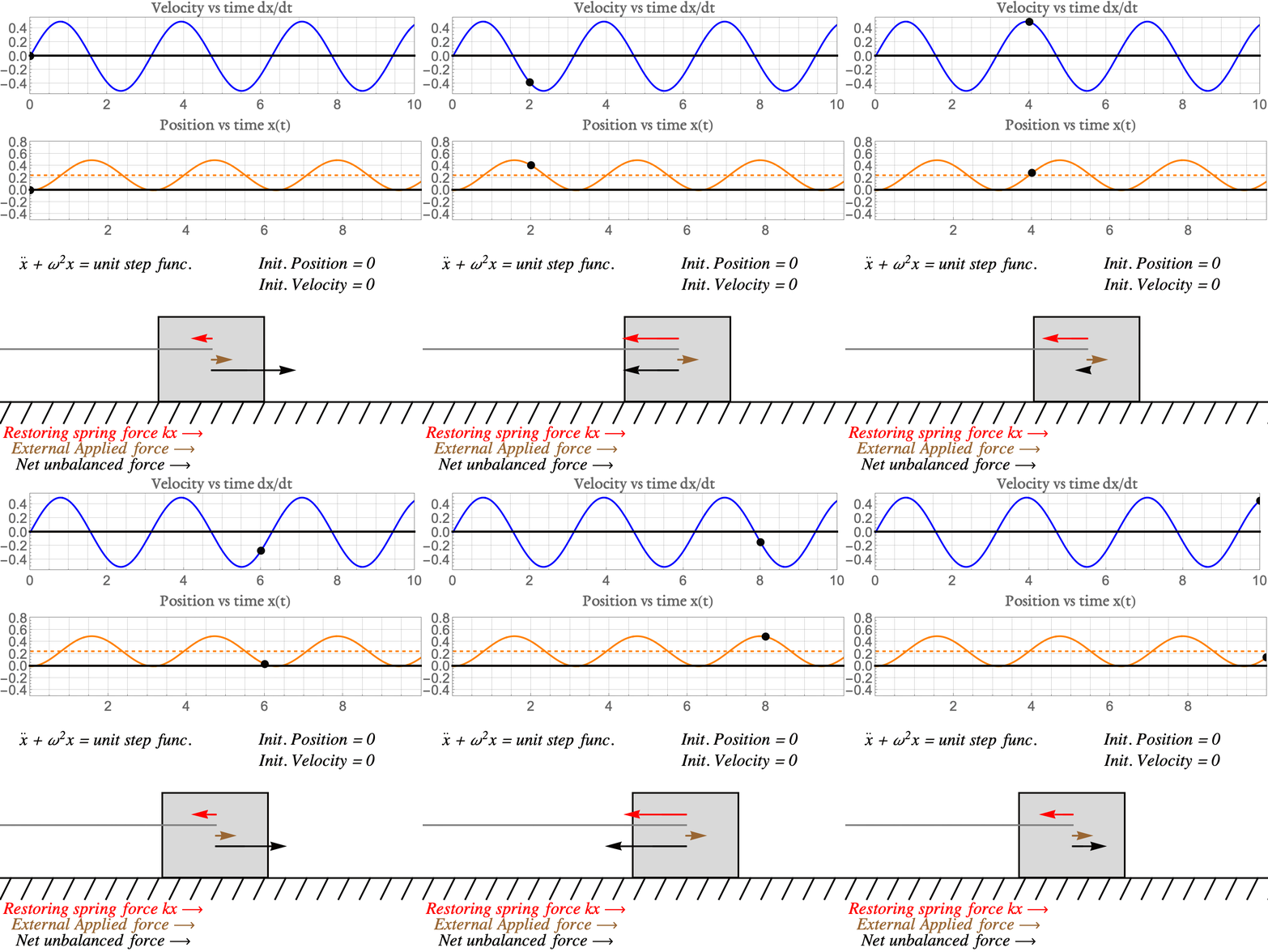
The term \(k l_0\) acts like a constant force, i.e., like a step function input
Measuring the length relative to \(l_0\)
\[m \ddot{x} = f - k (x-l_0)\]\[m \ddot{x} + kx = f + k l_0 \]
\[x_n = x - l_0\]\[\ddot{x}_n = \ddot{x}\]\[m \ddot{x}_n = f - k x_n\]\[m \ddot{x}_n + kx_n = f\]
We will often re-define our coordinates \(x\) to get rid of \(l_0\) in our equations.
A note about the ‘order’ of a system
We use the word ‘order’ to refer to two different things.
A ‘second order equation’ \[\ddot{x} = f(x,\dot{x},t)\]
A system of two first order equations \[ \dot{x}_1 = f_1(x_1,x_2,t) \\ \dot{x}_2 = f_2(x_1,x_2,t)\]
Both of these are ‘second order’
If using block diagrams, you will use two\(\frac{1}{s}\) blocks for each system above
Deciphering the order of a system
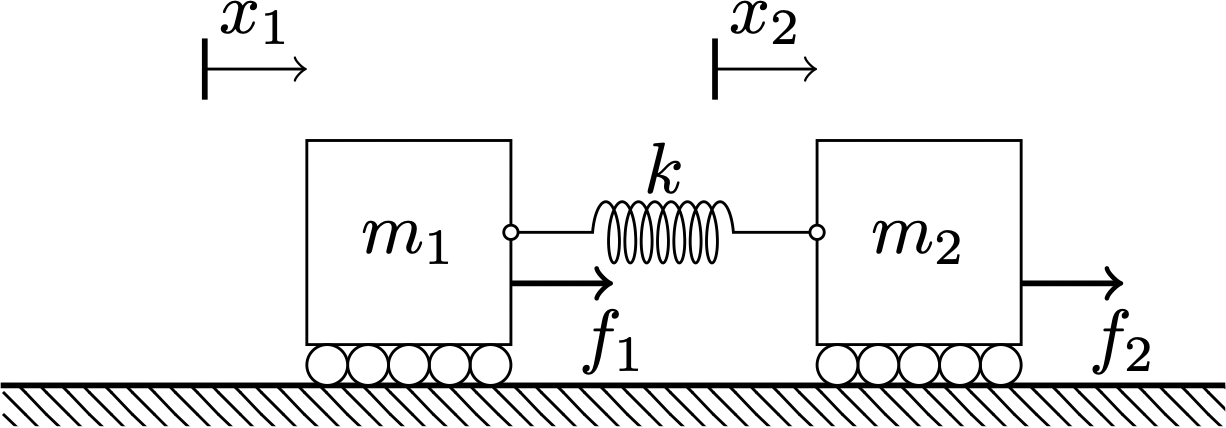
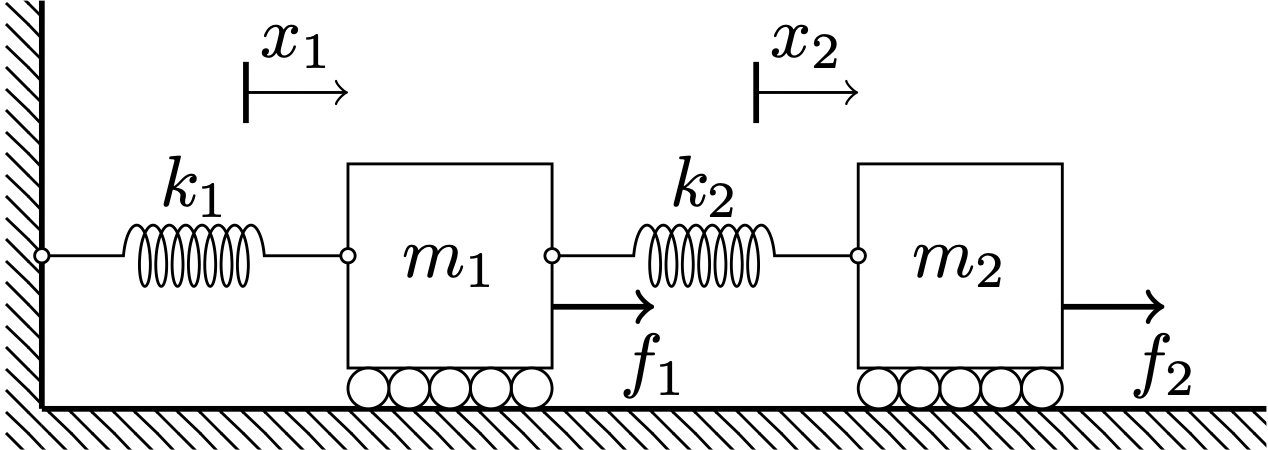
What is the order of this system?
Approach 1
Draw free-body diagrams for both systems and write Newton’s laws for each
MATLAB’s ode45 can be used to model second-order systems
\[m \ddot{x} + k x = 0 \implies \ddot{x} = -\frac{k}{m} x\]
functiondydt=rhs(t,y)% Implements the right-hand-side of the equation% dy/dt = f(y,t)% where y is a vector containing n state variables.% Here, we are interested in the equation m x'' + k x = 0% So y1 = x and y2 = x'.% un-pack contents of yy1=y(1);y2=y(2);% define constantsk=5;m=3;% Define what dy/dt isdy1dt=y2;dy2dt=-(k/m)*y1;% Assemble contents of dy/dt into a column vectordydt= [dy1dt;dy2dt];end
Using ode45 to model higher-order systems
2nd order, with forcing
If the function includes an input, MATLAB expects to incorporate this into the ‘right-hand side function’.
For example, if we have \[m \ddot{x} + k x = f(t) \implies \ddot{x} = -\frac{k}{m}x + f(t) \]
functiondydt=rhs(t,y)% Implements the right-hand-side of the equation% dy/dt = f(y,t)% where y is a vector containing n state variables.% Here, we are interested in the equation m x'' + k x = cos(2t)% So y1 = x and y2 = x'.% un-pack contents of yy1=y(1);y2=y(2);% define constantsk=5;m=3;% Define what dy/dt isdy1dt=y2;dy2dt=-(k/m)*y1+cos(2*t);% Assemble contents of dy/dt into a column vectordydt= [dy1dt;dy2dt];end
How to use ode45
In this class, you will usually not have to write code from scratch.
Please freely copy, re-use, and modify the code provided in class
Building an intuition for how to use ode45 takes time.
% Use ode45 from t = 0 to t = 10. Initial conditions are% x(0) = 1, x'(0) = 0[t,ysol] =ode45(@rhs,[0,10],[1;0]);% Make plot in one goplot(t,ysol);% Plots both columns of 'ysol' in one go% Make plot in n steps, where n = number of state variablesplot(t,ysol);% Plots both columns of 'ysol' in one golegend("x","x dot","Location","southeast");
Applying ode45 to spring-mass system
In-class activity: For each of the following scenarios, use MATLAB to plot graphs of position and velocity.
A spring-mass system is started from rest with a non-zero position. No force is applied.
A spring-mass system is subjected to a force \(\cos 2t\), starting from rest and the equilibrium position
A spring-mass system is subjected to the ‘hat’ function from HW 4