Lecture 14
E21 Computer Engineering Fundamentals
October 22, 2026
Bisection Method
Convergence rates
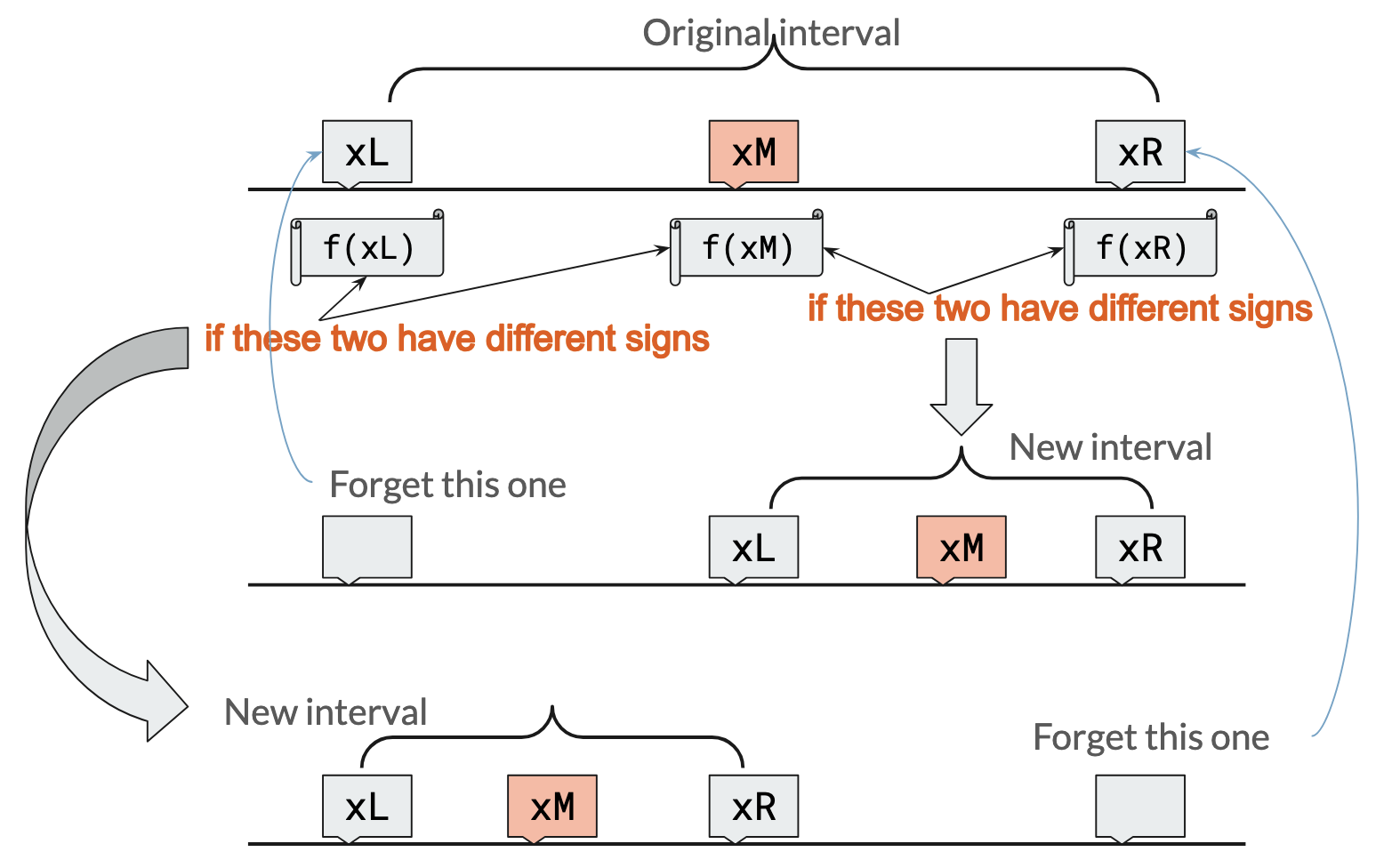
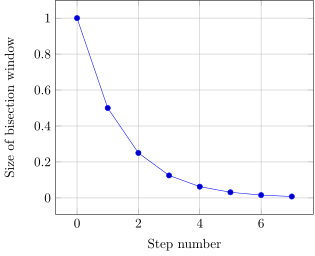
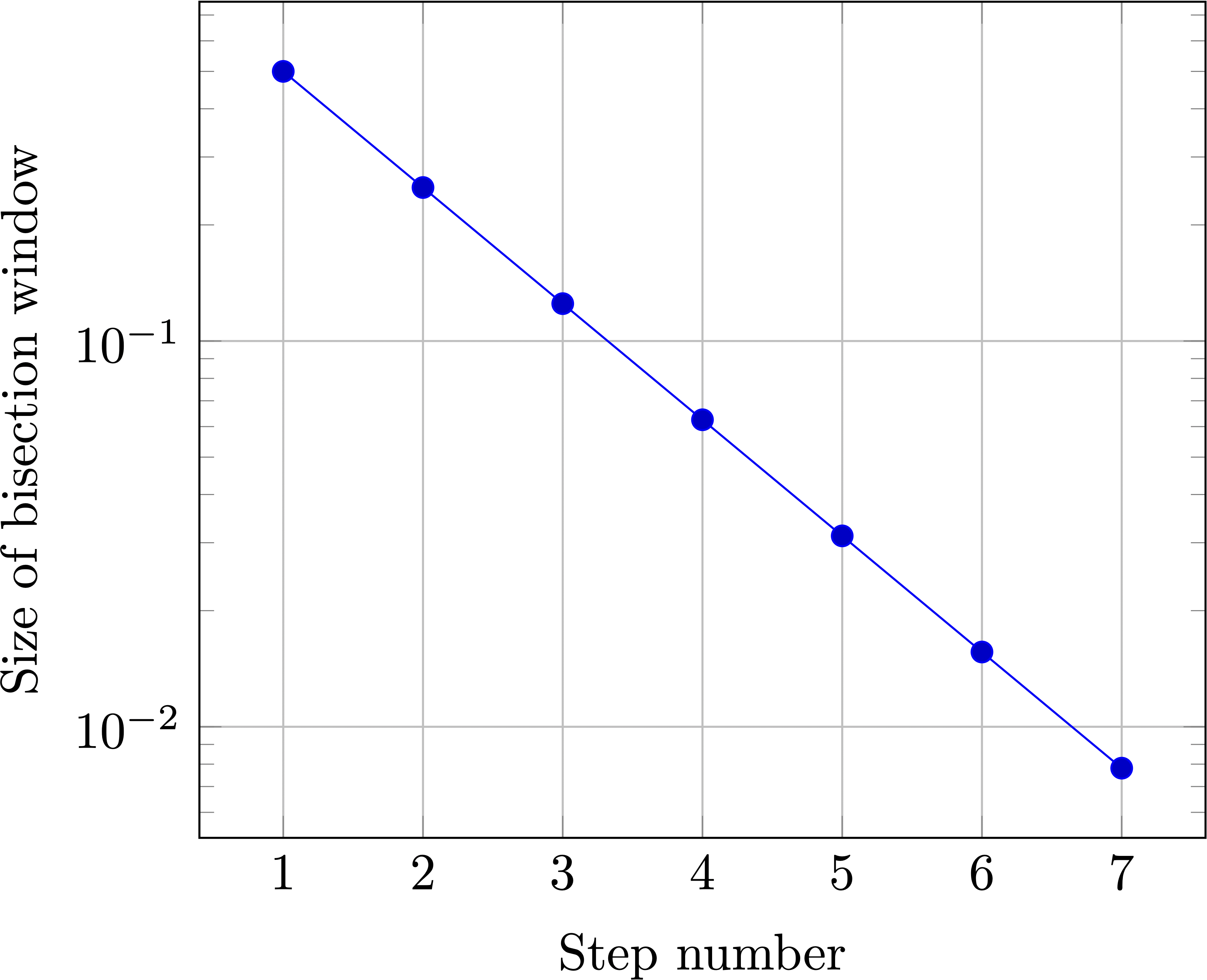
At each subsequent bisection step, the bisection window is halved.
The Secant Method
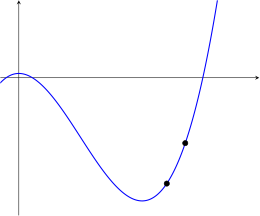
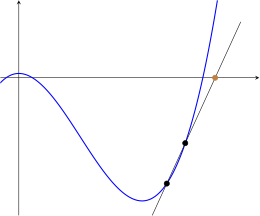
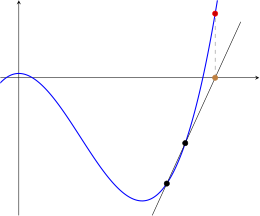
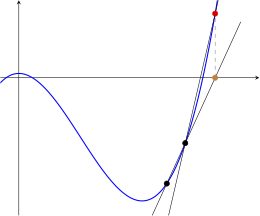
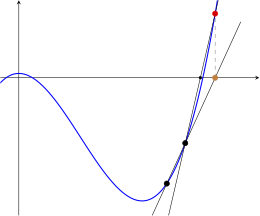
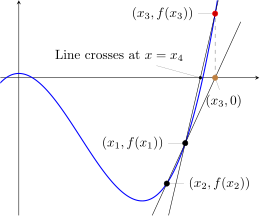
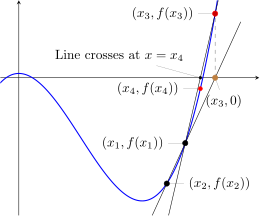
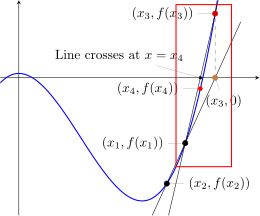
Secant Method — Zoomed in
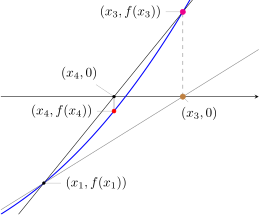
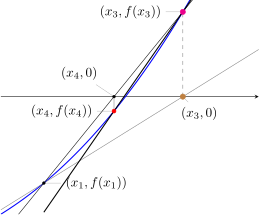
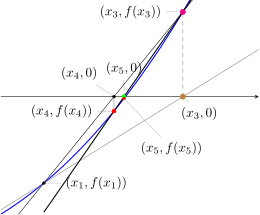
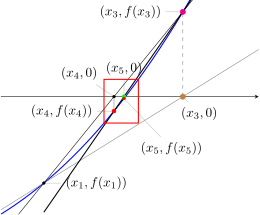
Secant Method — Zoomed in again
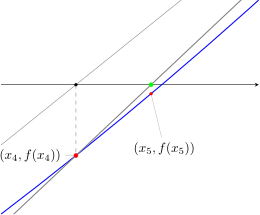
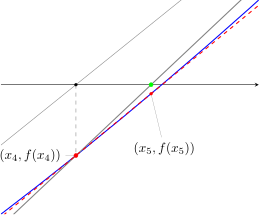
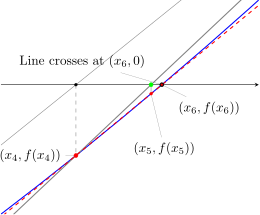
Summary of Secant Method
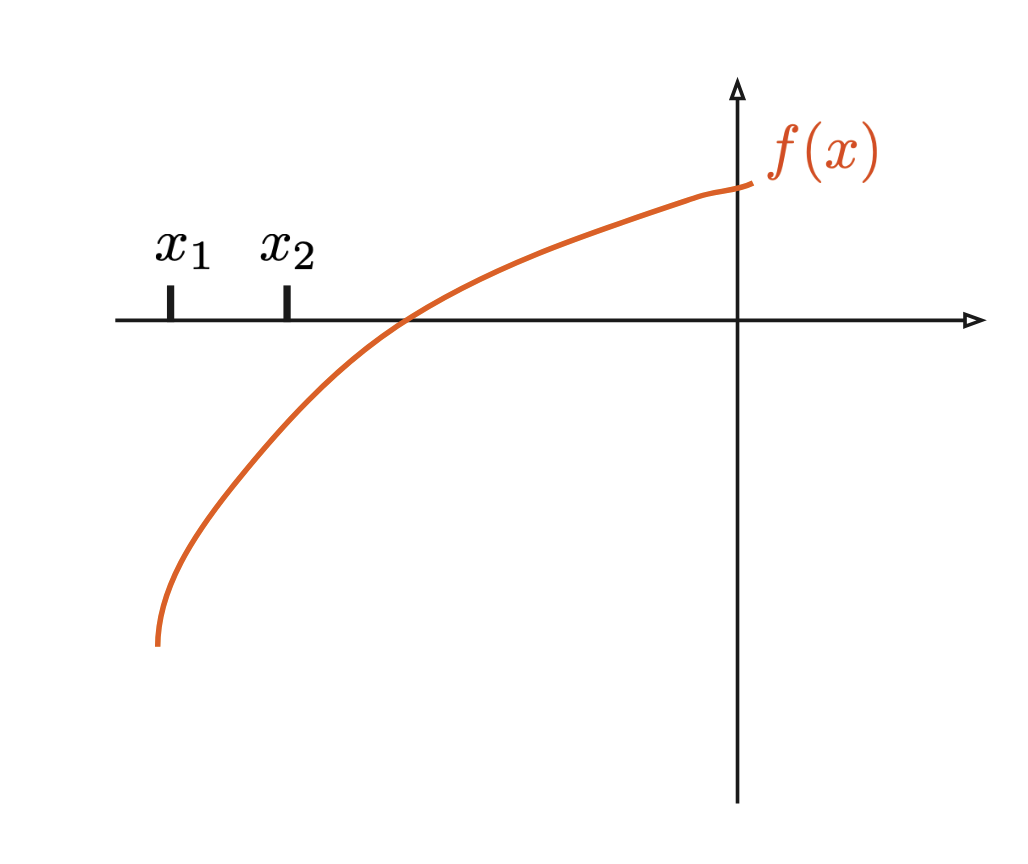
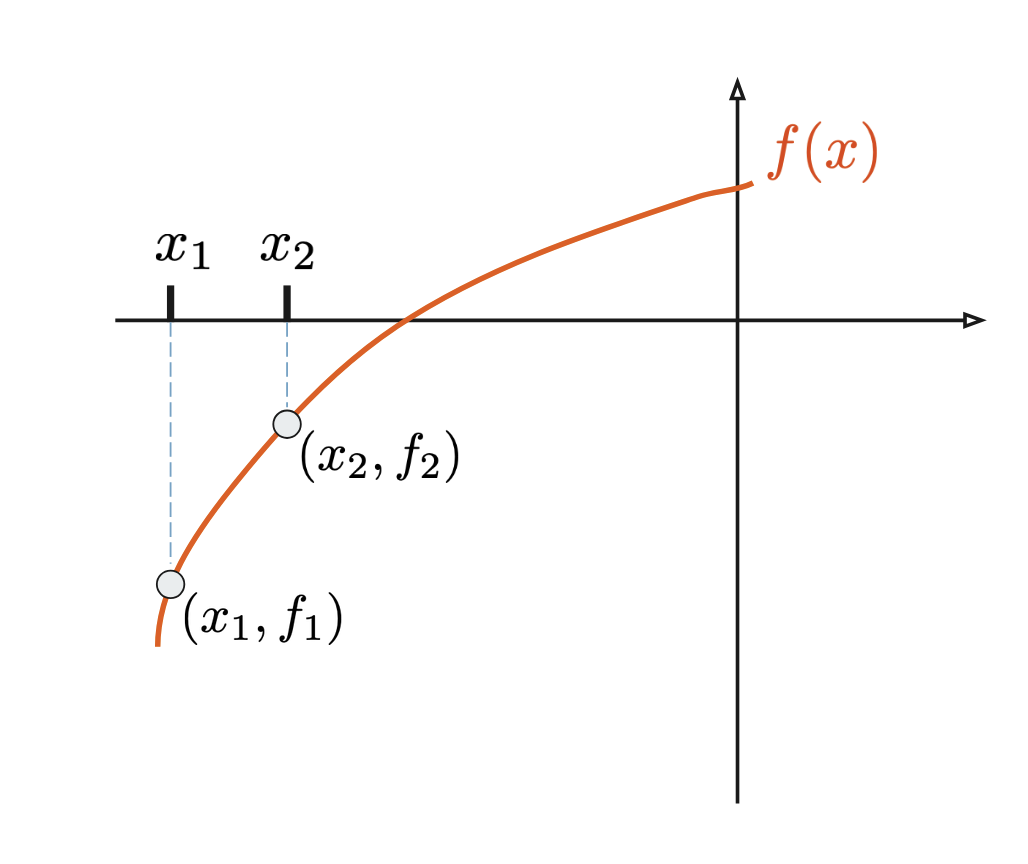
Start with two estimates of the root.
Evaluate the function at both \(x_1\) and \(x_2\)
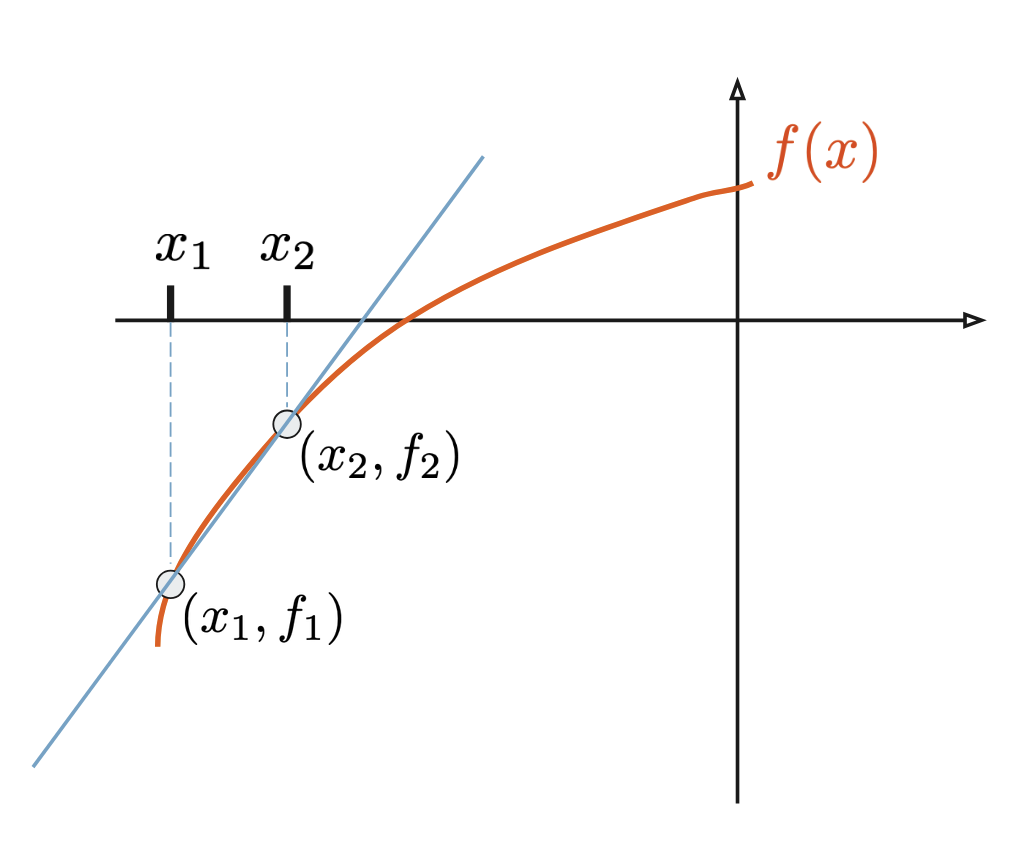
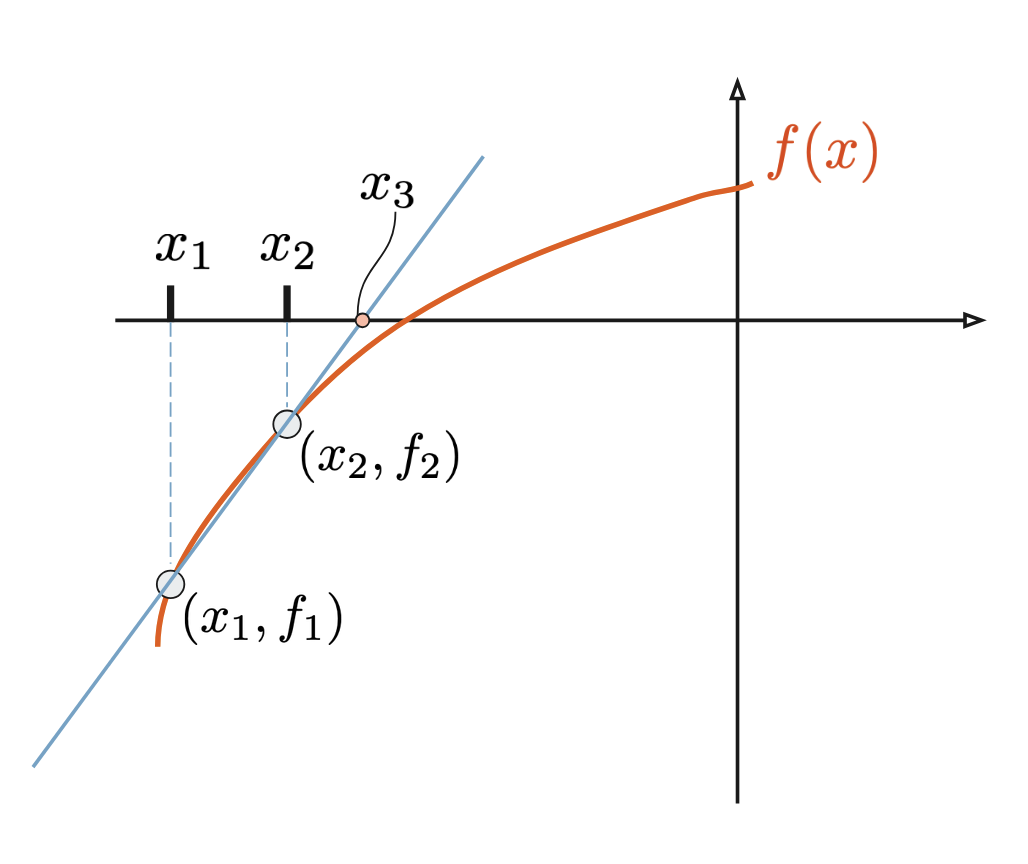
Draw a straight line between the two points. This is an estimate of the function’s behavior.
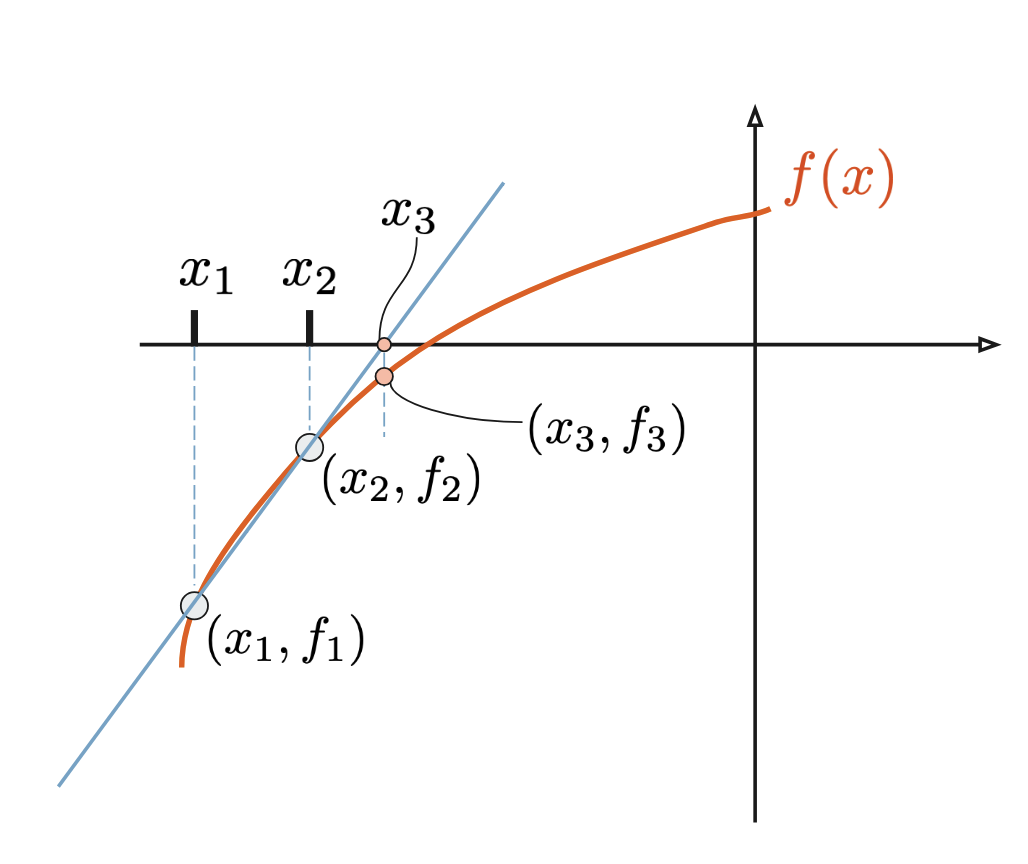
Locate the point \((x_3,0)\) where this line crosses the x-axis. Call this \(x_3\).
Let \((x_3,f_3)\) be a new point. Forget about \((x_1,f_1)\).
Repeat the process above, using the points \((x_2,f_2)\) and \((x_3,f_3)\)
Newton’s Method
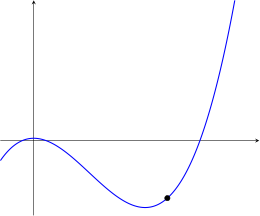
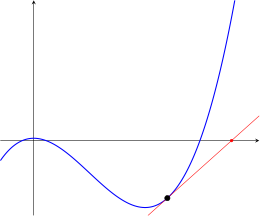
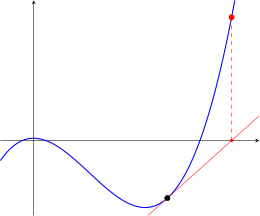
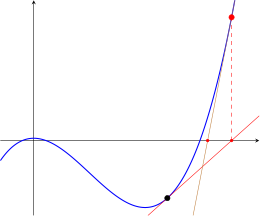
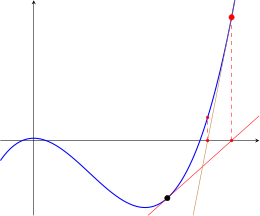
Summary of Newton’s Method
Evaluate the function at your first guess.
Make a straight line tangent to \((x_1,f_1)\)
Find location where this line intersects x-axis. This is the 2nd guess, call it \(x_2\).
Repeat.


Equations for Newton’s method
Derive an equation for \(x_{n+1}\) given \(x_n\)
Equation of the tangent line is \(y = mx+c\),
where \(m = f'(x_n)\). So we get \[y = f'(x_n) x + c\]
and \(c\) can be found by substituting a known point into the equation:
\(\underbrace{f(x_n)}_{\text{y coordinate}} = f'(x_n) \underbrace{x_n}_{\text{x coordinate}} + c \implies c = f(x_n) - f'(x_n) x_n\).
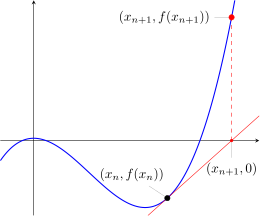
Thus, the equation of the straight line is \(\displaystyle{\color{red}{y}} = \overbrace{f'(x_n)}^{m} {\color{red}{x}} + \overbrace{f(x_n) - f'(x_n) x_n}^{c}\)
The intersection of this line with the \(x\) axis occurs when \(y=0\), i.e.:
\(0 =f'(x_n) {\color{red}{x}} + f(x_n) - f'(x_n) x_n\)
Recognizing that the unknown \({\color{red}{x}}\) is \(x_{n+1}\), we get \[f'(x_n) x_n - f(x_n)= f'(x_n) {\color{red}{x}} \implies \frac{f'(x_n) x_n - f(x_n)}{f'(x_n)} = {\color{red}{x}}\]
\[\implies \boxed{x_{n+1} = x_n - \frac{f(x_n)}{f'(x_n)}}\]
Example — Finding the wrong root
Suppose an equation is known to have multiple solutions, but only one of them is physically meaningful. A root-finding program will not necessarily find the solution we care about.
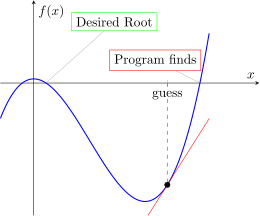
Example — Stuck in a flat place
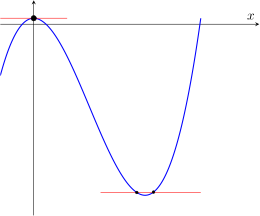
In the neighborhood of zero-slope points, these methods run into problems.