Lecture 19

E21 Computer Engineering Fundamentals

Emad Masroor

November 10, 2026

Today

Test 4

Starting Today

Final Project

Slides from Presentation

Polynomial Interpolation with two points

Goal: Find the equation of a straight line that passes through two known points

  1. The general equation of a polynomial of degree 1:

    \(y = a_0 + a_1 x\)

  2. ‘Plug in’ the given points as two equations

    \(\begin{aligned} y_0 &= a_0 + a_1 x_0 \\ y_1 &= a_0 + a_1 x_1\end{aligned}\)

  3. Solve two simultaneous equations for the two unknowns

    \(\begin{bmatrix} 1 & x_0 \\ 1 & x_1 \end{bmatrix} \begin{bmatrix} a_0 \\ a_1 \end{bmatrix} = \begin{bmatrix} y_0 \\ y_1 \end{bmatrix}\)

Find a straight line through 2 points \(\implies\) polynomial interpolation with degree 1

Polynomial Interpolation with three points

Goal: Find the equation of a straight line that passes through three known points

  1. The general equation of a polynomial of degree 1:

    \(y = a_0 + a_1 x\)

  2. ‘Plug in’ the given points as three equations

    \(\begin{aligned} y_0 &= a_0 + a_1 x_0 \\ y_1 &= a_0 + a_1 x_1 \\ y_2 &= a_0 + a_1 x_2 \end{aligned}\)

  3. Solve three simultaneous equations for the two unknowns

    \(\begin{bmatrix} 1 & x_0 \\ 1 & x_1 \\ 1 & x_2 \end{bmatrix} \begin{bmatrix} a_0 \\ a_1 \end{bmatrix} = \begin{bmatrix} y_0 \\ y_1 \\ y_2 \end{bmatrix}\)

Not possible — too many equations; system is overdetermined

Finding a quadratic curve that goes through all three points

Goal: Find the equation of a straight line that passes through three known points

  1. The general equation of a polynomial of degree 2:

    \(y = a_0 + a_1 x + a_2 x^2\)

  2. ‘Plug in’ the given points as three equations

    \(\begin{aligned} y_0 &= a_0 + a_1 x_0 + a_2 x_0^2 \\ y_0 &= a_0 + a_1 x_1 + a_2 x_1^2 \\ y_0 &= a_0 + a_1 x_2 + a_2 x_2^2 \end{aligned}\)

  3. Solve three simultaneous equations for the two unknowns

    \(\begin{bmatrix} 1 & x_0 & x_0^2 \\ 1 & x_1 & x_1^2 \\ 1 & x_2 & x_2^2 \end{bmatrix} \begin{bmatrix} a_0 \\ a_1 \\ a_2 \end{bmatrix} = \begin{bmatrix} y_0 \\ y_1 \\ y_2 \end{bmatrix}\)

Polynomial interpolation with degree 3

Interpolation through \(n+1\) points on a plane with a polynomial of order \(n\)

\[ \underbrace{\begin{bmatrix} x_0^0 & x_0^1 & x_0^2 & \cdots & x_0^n \\ x_1^0 & x_1^1 & x_1^2 & \cdots & x_1^n \\ \vdots & \vdots & \vdots & \ddots & \vdots \\ x_n^0 & x_n^1 & x_n^2 & \cdots & x_n^n \end{bmatrix}}_{A} \begin{bmatrix} a_0 \\ a_1 \\ \vdots \\ a_n \end{bmatrix} = \begin{bmatrix} y_0 \\ y_1 \\ \vdots \\ y_n \end{bmatrix} \]

The matrix \(A\) is a ‘Vandermonde Matrix’

A system of \(n+1\) equations for interpolating a polynomial of degree \(n\) through \(n+1\) points on the plane

Polynomial Interpolation Matrix

Let’s look at some examples of Vandermonde matrices:

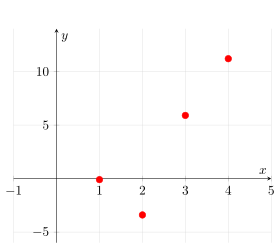
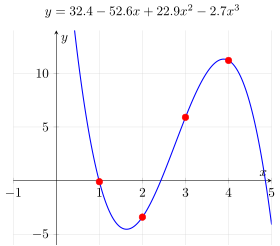
Calculate the Vandermonde matrix for for the interpolation of a cubic polynomial through the following four points: \(\begin{bmatrix} 1.0 \\ -0.1 \end{bmatrix}, \begin{bmatrix} 2.0 \\ -3.4 \end{bmatrix},\begin{bmatrix} 3.0 \\ 5.9 \end{bmatrix}, \begin{bmatrix} 4.0 \\ 11.2 \end{bmatrix}\)

\[ \begin{bmatrix} a_0 \\ a_1 \\ a_2 \\ a_3 \end{bmatrix} = \begin{bmatrix} x_0^0 & x_0^1 & x_0^2 & x_0^3 \\ x_1^0 & x_1^1 & x_1^2 & x_1^3 \\ x_2^0 & x_2^1 & x_2^2 & x_2^3 \\ x_3^0 & x_3^1 & x_3^2 & x_3^3 \end{bmatrix}^{-1} \begin{bmatrix} y_0 \\ y_1 \\ y_2 \\ y_3 \end{bmatrix} \]

\[ \begin{bmatrix} x_0^0 & x_0^1 & x_0^2 & x_0^3 \\ x_1^0 & x_1^1 & x_1^2 & x_1^3 \\ x_2^0 & x_2^1 & x_2^2 & x_2^3 \\ x_3^0 & x_3^1 & x_3^2 & x_3^3 \end{bmatrix} = \begin{bmatrix} 1 & 1 & 1 & 1 \\ 1 & 2 & 4 & 8 \\ 1 & 3 & 9 & 27 \\ 1 & 4 & 16 & 64 \\ \end{bmatrix} \]

Condition Number of Vandermonde matrices

Use Python to find the condition number (lecture 18) of the Vandermonde matrices for interpolating a polynomial to the following sets of points.

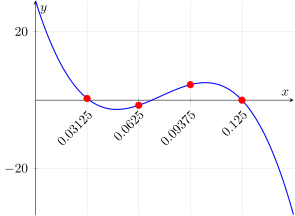
\(\overbrace{\begin{bmatrix} 0.03125 \\ 0.5 \end{bmatrix}, \begin{bmatrix} 0.0625 \\ -1.5 \end{bmatrix},\begin{bmatrix} 0.09375 \\ 4.5 \end{bmatrix}, \begin{bmatrix} 0.125 \\ 0 \end{bmatrix}}^{}\)

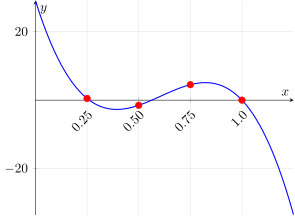
\(\underbrace{\begin{bmatrix} 0.25 \\ 0.5 \end{bmatrix}, \begin{bmatrix} 0.5 \\ -1.5 \end{bmatrix},\begin{bmatrix} 0.75 \\ 4.5 \end{bmatrix}, \begin{bmatrix} 1.0 \\ 0 \end{bmatrix}}_{}\)

\(\boxed{50,373}\)

\(\boxed{331.35}\)

def vandermonde_matrix(xlist):
    # Creates a Vandermonde matrix from the x-positions in `xlist`
    n = len(xlist)
    A = np.zeros((n,n),dtype=np.float64)
    for i,el in enumerate(xlist):
        for j in range(n):
            A[j,i] = xlist[j]**i
    return A

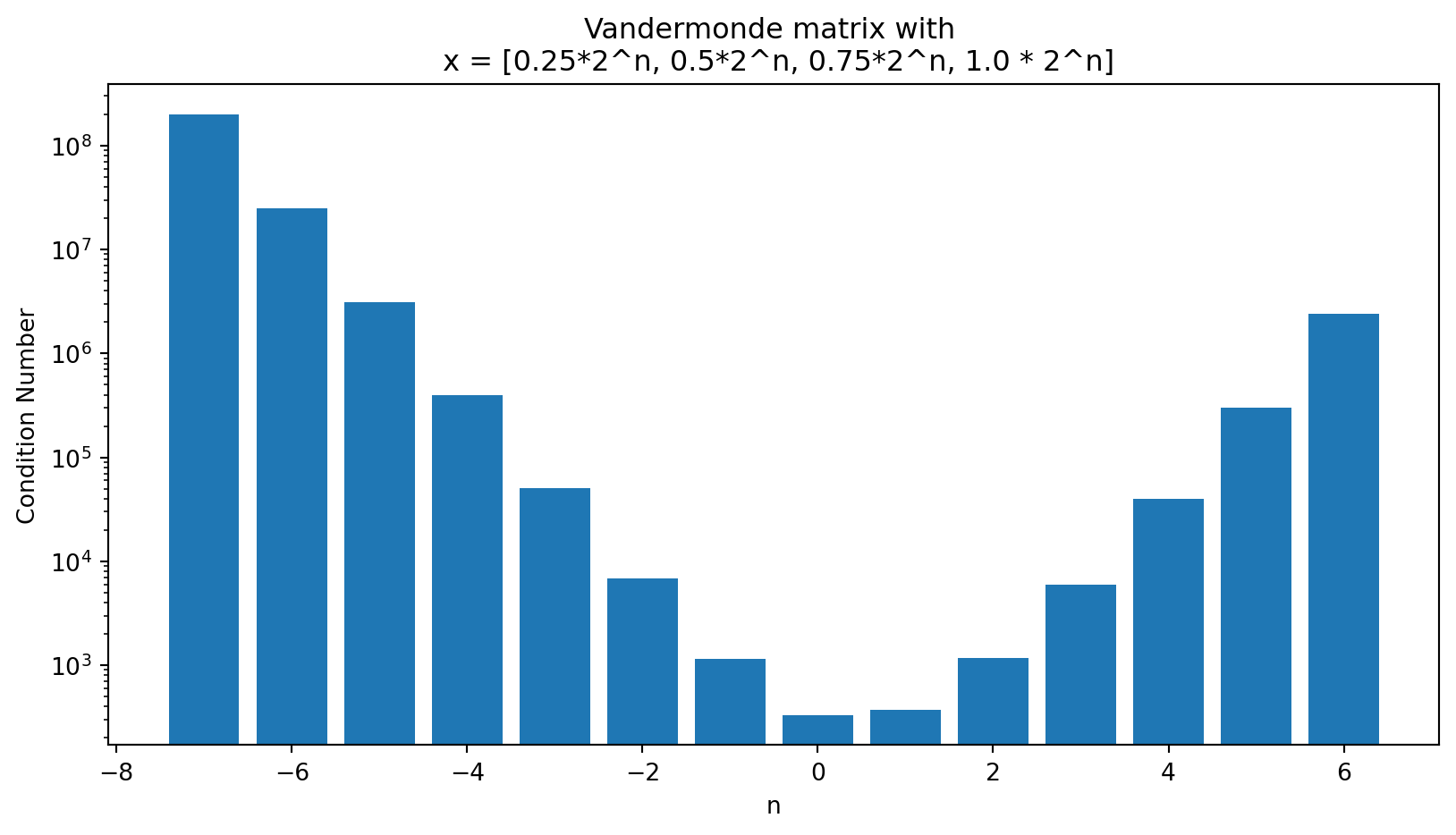
The interval over which interpolation is carried out greatly affects condition number

Condition Number versus Interpolation interval

With n = -7
For a vandermonde matrix made of [0.001953125, 0.00390625, 0.005859375, 0.0078125]
Condition number is 200104475.54951715
With n = -6
For a vandermonde matrix made of [0.00390625, 0.0078125, 0.01171875, 0.015625]
Condition number is 25022246.383165702
With n = -5
For a vandermonde matrix made of [0.0078125, 0.015625, 0.0234375, 0.03125]
Condition number is 3132373.3468269915
With n = -4
For a vandermonde matrix made of [0.015625, 0.03125, 0.046875, 0.0625]
Condition number is 393841.132037466
With n = -3
For a vandermonde matrix made of [0.03125, 0.0625, 0.09375, 0.125]
Condition number is 50373.99224592936
With n = -2
For a vandermonde matrix made of [0.0625, 0.125, 0.1875, 0.25]
Condition number is 6863.662615671886
With n = -1
For a vandermonde matrix made of [0.125, 0.25, 0.375, 0.5]
Condition number is 1141.842454808791
With n = 0
For a vandermonde matrix made of [0.25, 0.5, 0.75, 1.0]
Condition number is 331.35123199279394
With n = 1
For a vandermonde matrix made of [0.5, 1.0, 1.5, 2.0]
Condition number is 371.4719547885741
With n = 2
For a vandermonde matrix made of [1.0, 2.0, 3.0, 4.0]
Condition number is 1176.9374570374491
With n = 3
For a vandermonde matrix made of [2.0, 4.0, 6.0, 8.0]
Condition number is 5956.8876457098895
With n = 4
For a vandermonde matrix made of [4.0, 8.0, 12.0, 16.0]
Condition number is 39921.7781032595
With n = 5
For a vandermonde matrix made of [8.0, 16.0, 24.0, 32.0]
Condition number is 302978.9615841781
With n = 6
For a vandermonde matrix made of [16.0, 32.0, 48.0, 64.0]
Condition number is 2390434.3340785685
Problems with Polynomial interpolation

  • Under certain conditions, an interpolating polynomial is guaranteed to exist mathematically.
    • Restrictions:
      • Number of points and degree of polynomial must be compatible
      • No two points can have the same \(y\) value
  • Large condition numbers cause problems
    • Even though the mathematical problem is typically solvable
    • One solution: use Newton’s method (ch.3.2 of textbook) for interpolating a polynomial

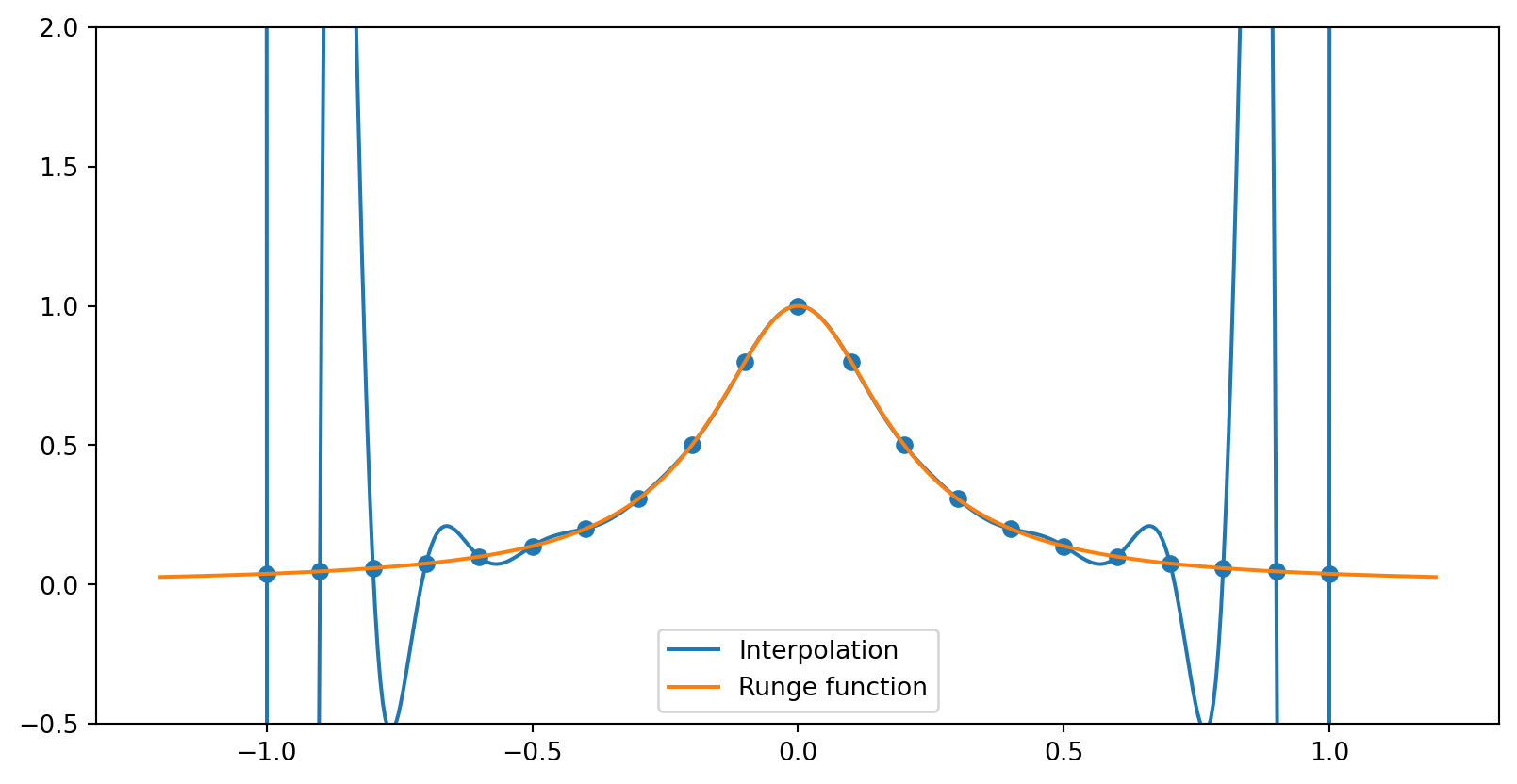
Runge’s Phenomenon

\[f(x) = \frac{1}{1+25 x^2}\]

Find an interpolating polynomial that passes through 5 equally spaced points on \(f(x)\) from \(x=-1\) to \(x=+1\)