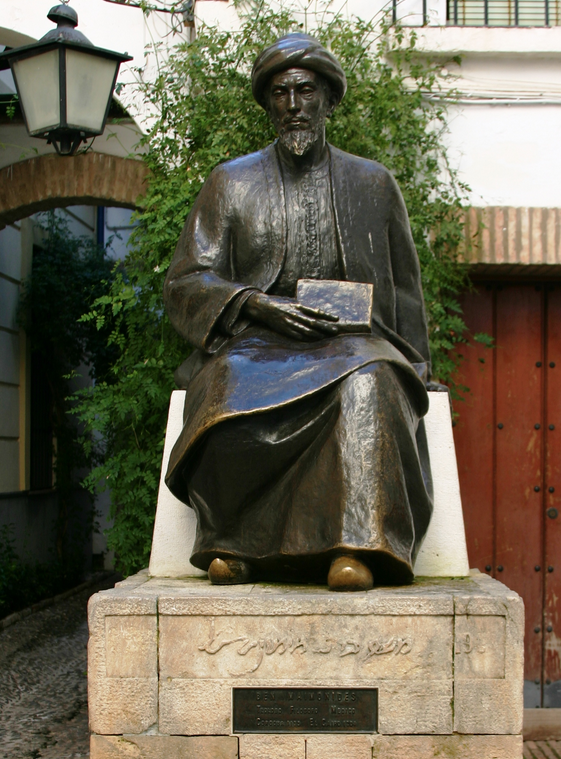
This is a personal website dedicated to the study of The Guide for the Perplexed (dalalat al-haa’ireen دلالة الحائرين or moreh nebuchim מורה נבוכים), the philosophical magnum opus of Musa bin Maimun (موسى بن ميمون; known in Hebrew as Moshe ben Maimon משה בן-מימון, and in the European intellectual tradition as Maimonides).
About the book
The Guide for the Perplexed was written c. 1190 in Cairo, and was originally written in Classical Arabic using the Hebrew script. See the Translations & Transliterations page for details about the numerous translations and transliterations of this book that have been made over the centuries from the 12th to the 21st.
Broadly, the Guide is about the relationship between Reason and Revelation. In addressing this topic, Maimonides wades into a number of medieval philosophical/theological debates, such as:
- the nature of prophecy,
- the problem of evil,
- the eternity of the universe,
- the question of Divine attributes,
- the purposes of the Law, and
- human perfection
In his own words,
The object of this treatise is to enlighten a religious man who has been trained to believe in the truth of our holy Law, who conscientiously fulfils his moral and religious duties, and at the same time has been successful in his philosophical studies. Human reason has attracted him to abide within its sphere; and he finds it difficult to accept as correct the teaching based on the literal interpretation of the Law, and especially that which he himself or others derived from those homonymous, metaphorical, or hybrid expressions. Hence he is lost in perplexity and anxiety. If he be guided solely by reason, and renounce his previous views which are based on those expressions, he would consider that he had rejected the fundamental principles of the Law; and even if he retains the opinions which were derived from those expressions, and if, instead of following his reason, he abandon its guidance altogether, it would still appear that his religious convictions had suffered loss and injury. For he would then be left with those errors which give rise to fear and anxiety, constant grief and great perplexity.
It begins with the following phrase
This book [is] a key admitting to places the gates of which would otherwise be closed. When the gates are opened and men enter, their souls will enjoy repose, their eyes will be gratified, and their bodies will be eased of their toil and labour.
and ends with a quotation of the following Scriptural passages:
“Then the eyes of the blind shall be opened, and the ears of the deaf shall be unstopped” (Isa. 35:5); “The people that walked in darkness have seen a great light; they that dwell in the shadow of death upon them hath the light shined” (Isa. 9:1).
About the website
Here, you will find the beginnings of a personal commentary on the Guide with extensive quotations from Friedlander’s translation, in the form of chapter summaries. The full text of each chapter is also made available here from five sources:
- the English translation of Michael Friedländer
- the English translation of Lenn Goodman and Philip Lieberman
- the Judeo-Arabic recension of Salomon Munk
- the French translation of Salomon Munk
- the Hebrew text from Samuel Ibn Tibbon (edition unknown)
Read more about these editions, including a line-by-line comparison of a famous passage from the guide, on the Translations & Transliterations page.
You may also be interested in reading about the commentarial tradition, but this part of the website is hopelessly incomplete as of 2026.
Hyperlinks are included to the text of the Guide in English, Hebrew and Judeo-Arabic on Sefaria as well as the archive.org scan of Husseyin Attai’s Arabic-script edition.