Homework 0 Solutions
- Factorize the following expression, i.e., express it as the product of (two) terms: \[x^2 + 2x - 35\] and use the result to write down all solutions of the equation \(x^2 + 2x - 35 = 0\)
It is straightforward to determine that \[x^2+2x-35 = (x-5)(x+7)\] and that the equation \(x^2 + 2x - 35 = 0\) has solutions \(x=+5\) and \(x=-7\).
- Factorize the following expression, i.e., express it as the product of (two) terms: \[x^2 -2x + 5\] and use the result to write down all solutions of the equation \(x^2 -2x + 5=0\)
Let us write the equation \[(x-\lambda_1)(x-\lambda_2) = x^2 -2x + 5.\] If we can succeed in expressing the quadratic expression in this form, then the solution to the equation \(x^2 -2x + 5 = 0\) will simply be \(x=\lambda_1\) and \(x=\lambda_2\).
\[ \begin{aligned} x^2 -\lambda_1 x - \lambda_2 x + \lambda_1 \lambda_2 &= x^2 - 2x + 5 \\ \implies \lambda_1 x - \lambda_2 x &= - 2x \\ \text{ and } \lambda_1 \lambda_2 &= 5 \end{aligned} \]
We have two equations for two unknowns. However, the simultaneous equations
\[ \begin{aligned} \lambda_1 + \lambda_2 &= 2 \\ \lambda_1 \lambda_2 &= 5 \end{aligned} \]
don’t have any real solutions. We need complex numbers! This is a round-about way of doing this, but let’s substitute \(\lambda_1 = z\) and therefore \(\lambda_2 = 2 - z\). We now have a quadratic equation
\[z(2-z) = 5 \implies z^2 - 2z + 5 = 0\]
which is identical to the original equation. Let’s now use the quadratic formula:
\[ \begin{aligned} z &= \frac{2 \pm \sqrt{4-4 \cdot 1 \cdot 5}}{2 \cdot 1} \\ &= \frac{2 \pm \sqrt{-16}}{2} \\ &= \frac{2 \pm i\sqrt{16}}{2} \\ &= \frac{2 \pm 4i}{2} \\ &= 1 \pm 2 i \end{aligned} \]
so the two solutions to \(x^2 -2x + 5 = 0\) are \(x = 1+ 2i\) and \(x=1-2i\).
- Integration by parts. Calculate the following indefinite integral. \[\int x^2 e^x dx\]
Integration by parts makes use of the product rule to say that \[\int u dv = u v - \int v du. \tag{1}\]
Choose \(u = x^2\) and \(dv = e^x dx\). Thus, by construction,
\[ \begin{aligned} \int x^2 e^x dx = \int u dv \end{aligned} \]
and we can proceed with the ‘product rule’. First, make a table like the following.
| \(u\) | \(v\) |
|---|---|
| \(u= x^2\) | \(dv = e^x dx\) |
| \(du = 2 x dx\) | \(v = e^x\) |
Then, write
\[ \begin{aligned} \int x^2 e^x dx &= \int u dv = uv - \int v du \\ \implies \int x^2 e^x dx &= e^x \cdot x^2 - \int 2x e^x dx \end{aligned} \]
but our expression still has an integration symbol that we have not fully resolved. We need to use integration by parts again to find out what \(\int 2x e^x dx\). This time, we will re-use \(u\) and \(v\) as follows:
| \(u\) | \(v\) |
|---|---|
| \(u= 2x\) | \(dv = e^x dx\) |
| \(du = 2 dx\) | \(v = e^x\) |
and write
\[ \begin{aligned} \int 2x e^x dx &= \int u dv = uv - \int v du \\ \implies \int 2x e^x dx &= 2x \cdot e^x - \int 2 e^x dx \\ &= 2x \cdot e^x - 2 e^x \end{aligned} \]
We can now put this information together to say
\[ \begin{aligned} \int x^2 e^x dx &= e^x \cdot x^2 - \left( 2x \cdot e^x - 2 e^x \right) \\ &= e^x \cdot x^2 - e^x \cdot 2x + 2 e^x \\ &= e^x (x^2 - 2x + 2) + \text{ const.} \end{aligned} \]
- Solve the following system of simultaneous equations and give your answer in terms of fractions.
\[ \begin{aligned} 2x+3y &= 5 \\ -3x + 4y &= 6 \end{aligned} \]
\[x = \frac{2}{17}, \quad y = \frac{27}{17}\]
- For each of the following pair of simultaneous equations, is there: (a) one solution (b) infinitely many solutions or (c) no solution? Choose one option for each pair of equations below. \[ \begin{aligned} 2x+3y&=5 \\ -3x+4y &= 1 \end{aligned} \tag{2}\] \[ \begin{aligned} 2x+3y&=5 \\ 4x+6y &= 10 \end{aligned} \tag{3}\] \[ \begin{aligned} 2x+3y&=5 \\ 4x+6y &= 9 \end{aligned} \tag{4}\] Illustrate your answer with the help of graphs of the straight lines represented by each equation above. Your graphs should be on the same set of axes and should be properly labeled so that each line can be distinguished from the other. There should be four lines in total.
Based on the following diagram:
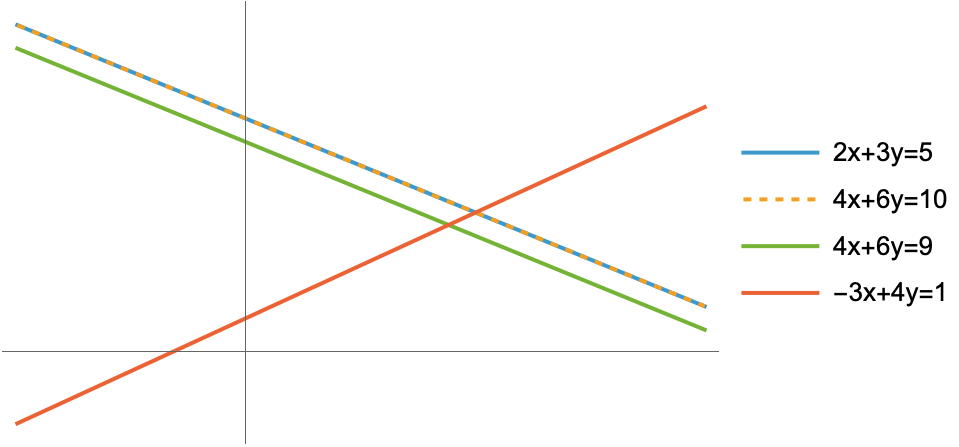
We can say that
- Equation 2 has one solution
- Equation 3 has no solutions
- Equation 4 has infinitely many solutions
- An object falls from a height \(h\) (meters) above the ground, on a planet where the acceleration due to gravity is a constant \(g\) (meters per second squared). Write down a formula for the time it takes for the object to reach the ground in the absence of air resistance, and show how this formula is derived.
\[\sqrt{\frac{2h}{g}}\]
- You are driving a car at a constant speed \(u\) meters per second. At some instant, you suddenly apply the brakes, which exert a deceleration equal to \(a\) meters per seconds squared on the car. Write down a formula for the distance traveled by the car before it comes to a complete stop. Your formula should be in terms of \(a\) and \(u\) and should contain no other variables.
For constant acceleration, the time it takes to stop is \[t = \frac{v-u}{a},\] where \(u\) is the initial speed and \(v\) the final speed. Since \(v\) is zero, and since deceleration is negative, we have \(t = u/a\).
We plug this into the formula \[s = ut + \frac{1}{2} a t^2,\]
which gives the stopping distance to be
\[ \begin{aligned} s &= u \cdot \frac{u}{a} - \frac{1}{2} a \left(\frac{u}{a}\right)^2 \\ s &= \frac{u^2}{2a} \end{aligned} \]