Lecture 18
E12 Linear Physical Systems Analysis
Forced Response of 1st order systems
\[\dot{x} + ax = f(t)\]
| Input | \(f(t)\) | \(F(s)\) | Response \(X(s)\) | Response \(x(t)\) |
|---|---|---|---|---|
Step  |
\(b u_s(t)\) | \(\displaystyle \frac{b}{s}\) | \(\displaystyle \frac{b}{s} \frac{1}{s+a}\) | \(\displaystyle \frac{b}{a} \left( 1 - e^{-at} \right)\) 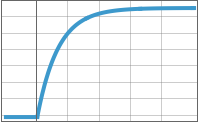 |
Impulse 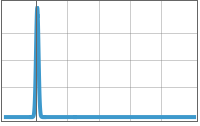 |
\(A \delta(t)\) | \(A\) | \(A \displaystyle\frac{1}{s+a}\) | \(\displaystyle A e^{-at} \phantom{\left( 1 - e^{-at} \right)}\) 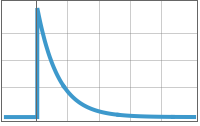 |
Ramp 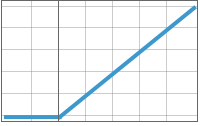 |
\(u_s(t) \cdot c t\) | \(\displaystyle \frac{c}{s^2}\) | \(\displaystyle \frac{c}{s^2} \frac{1}{s+a}\) | \(\displaystyle \frac{c}{a^2} \left( e^{-at} - 1\right) + \frac{c}{a} t\) 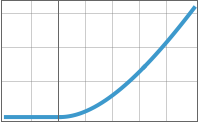 |
Sinusoid 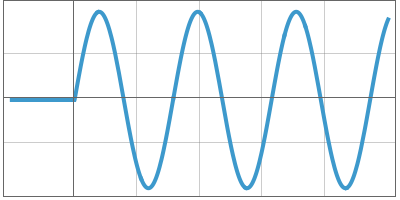 |
\(u_s(t) \cdot \sin \omega t\) | \(\displaystyle \frac{\omega}{s^2+\omega^2}\) | \(\displaystyle \frac{\omega}{s^2+\omega^2} \frac{1}{s+a}\) | \(\displaystyle \phantom{\frac{c}{a^2} \left( e^{-at} - 1\right) + \frac{c}{a} t}\) 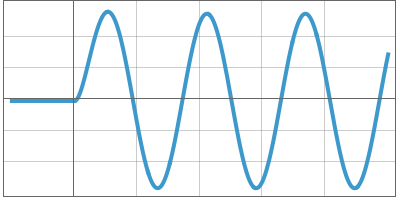 |
What about second-order systems?
\[m \ddot{x} + b \dot{x} + kx = f(t)\]
| Input | \(f(t)\) | \(F(s)\) | Response \(X(s)\) | Response \(x(t)\) |
|---|---|---|---|---|
Step  |
\(b u_s(t)\) | \(\displaystyle \frac{b}{s}\) | \(\displaystyle \frac{b}{s} \frac{1}{ms^2 + b s + k}\) | \(\displaystyle \phantom{\frac{b}{a} \left( 1 - e^{-at} \right)}\) |
Impulse 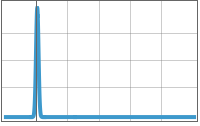 |
\(A \delta(t)\) | \(A\) | \(A \displaystyle \frac{1}{ms^2 + b s + k}\) | |
Ramp 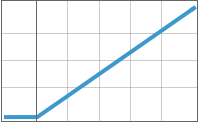 |
\(u_s(t) \cdot c t\) | \(\displaystyle \frac{c}{s^2}\) | \(\displaystyle \frac{c}{s^2} \frac{1}{ms^2 + b s + k}\) | |
Sinusoid 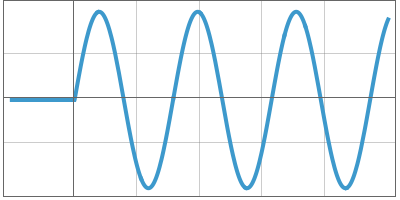 |
\(u_s(t) \cdot \sin \omega t\) | \(\displaystyle \frac{\omega}{s^2+\omega^2}\) | \(\displaystyle \frac{\omega}{s^2+\omega^2} \frac{1}{m s^2 + bs + k}\) |
Standard Form of a second-order linear system
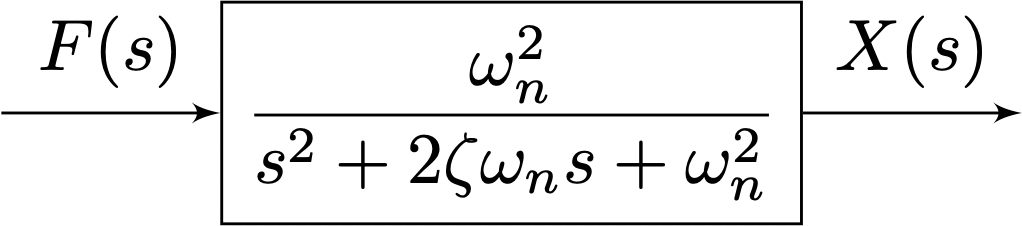
Poles and Roots
Nearly all frequency-domain functions we encounter in E12 are rational functions
\(\displaystyle F(s) = \frac{N(s)}{D(s)}\) \(\displaystyle = \frac{b_m s^m + b_{m-1} s^{m-1} + ... + b_0 s^0}{s^n + a_{n-1} s^{n-1} + ... + a_0 s^{0}}\)
The equation \(D(s)=0\) has \(n\) solutions — i.e., the polynomial \(D(s)\) has \(n\) roots \(s_1, s_2, ... s_n\)
These values are known as the poles of \(F(s)\).
We can use the poles to re-write \(D(s)\): \[D = s^n + a_{n-1} s^{n-1} + ... + a_0 s^{0} = (s-s_1)(s-s_2)...(s-s_n)\]
usually, we have \(m<n\)
The zeros of \(F(s)\) are the roots of polynomial \(N(s)\)
The poles of \(F(s)\) are the roots of polynomial \(D(s)\)
Partial Fraction Expansion for Distinct Poles
Let \(F(s)=\frac{N(s)}{D(s)}\) where \(D(s)\) has \(n\) distinct roots. Then we can use partial fractions to expand
\[F(s) = \frac{N(s)}{D(s)} = \frac{A_1}{s-s_1} + \frac{A_2}{s-s_2} + ... + \frac{A_n}{s-s_n} \tag{1}\]
- If the poles \(s_1,s_2,...,s_n\) are real, then \(A_1,A_2,...,A_n\) are also real
\[f(t) = A_1 e^{s_1t} + A_2 e^{s_2t} + ... + A_n e^{s_nt} \]
- A general formula for \(A_i\) can be written. Let’s derive this:
- Multiply Equation 1 by \(s-s_i\) \[(s-s_i)F(s) = \frac{A_1 (s-s_i)}{s-s_1} + \frac{A_2 (s-s_i)}{s-s_2} + ... + \frac{A_i (s-s_i)}{s-s_i} + ... + \frac{A_n (s-s_i)}{s-s_n}\]
- Take the limit as \(s \rightarrow \color{red}{s_i}\) \[ \lim_{s\rightarrow s_i} \left[ (s-s_i)F(s) \right] = \frac{A_1 (\color{red}{s_i}-s_i)}{s_i-s_1} + \frac{A_2 (\color{red}{s_i}-s_i)}{s-s_2} + ... + \frac{A_i (\color{red}{s_i}-s_i)}{s-s_i} + ... + \frac{A_n (\color{red}{s_i}-s_i)}{s-s_n}\]
- Almost all terms on the r.h.s. drop out \[ \lim_{s\rightarrow s_i} \left[ (s-s_i)F(s) \right] = 0 + 0 + ... + A_i + ... + 0\]
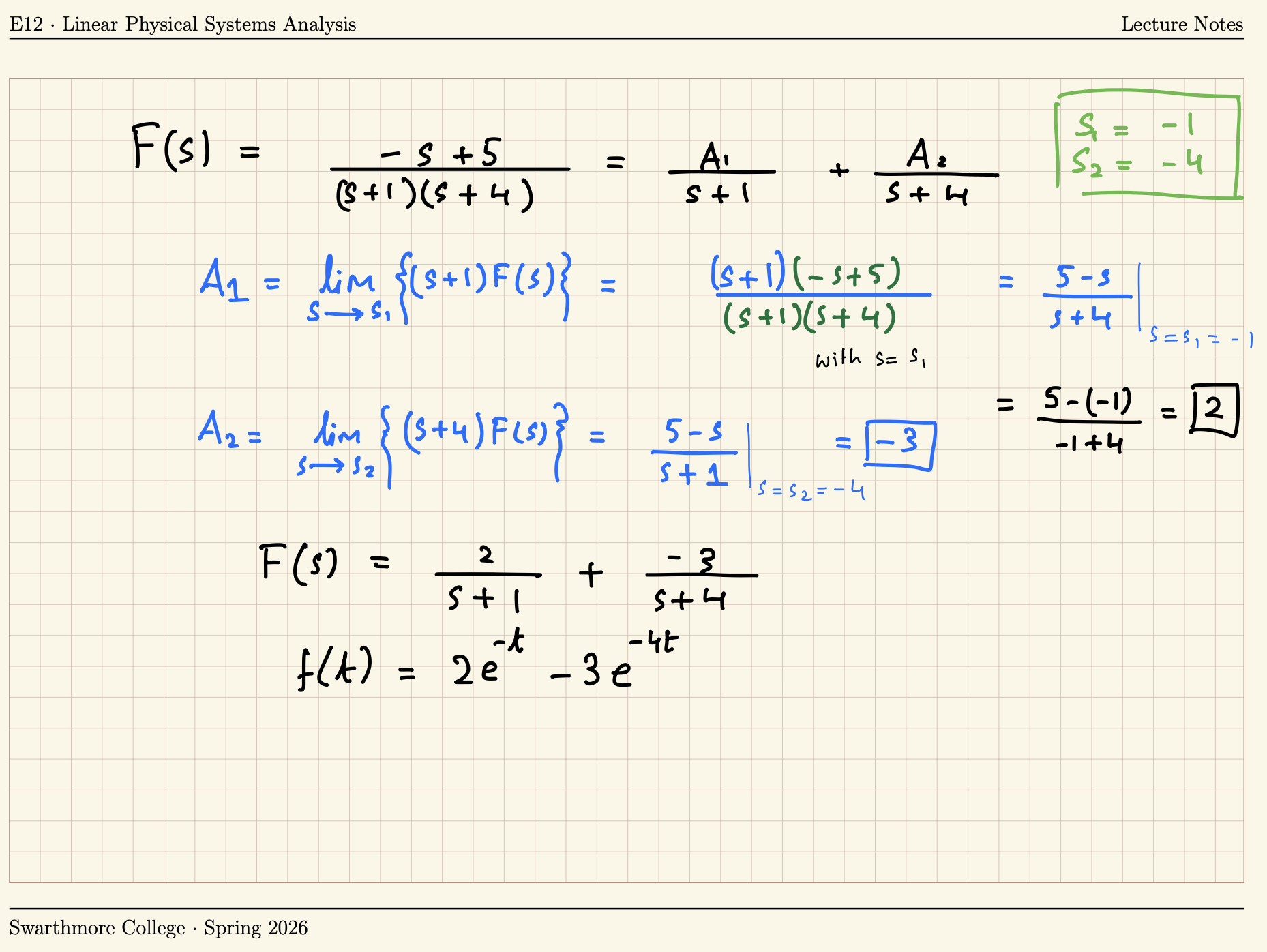
- Giving us a formula for how to find the constants \(A_i\) in Equation 1 \[A_i = \lim_{s\rightarrow s_i} \left[ (s-s_i)F(s) \right] \]
Practice
Find the inverse Laplace Transform of the following function: \[F(s) = \frac{5-s}{s^2 + 5s + 4}\]
Partial Fraction Expansion for Repeated Poles
Let \(F(s)=\frac{N(s)}{D(s)}\) where \(D(s)\) has \(2\) repeated poles and \(n-2\) distinct poles. Then we can use partial fractions to expand
\[F(s) = \frac{N(s)}{D(s)} = \frac{A_{11}}{(s-s_1)^2} + \frac{A_{12}}{s-s_1} + \frac{A_3}{s-s_3} + ... + \frac{A_n}{s-s_n} \tag{2}\]
If the poles \(s_1,s_2,...,s_n\) are real, then \(A_1,A_2,...,A_n\) are also real.
In the time domain, Equation 2 becomes \[f(t) = A_{11} t e^{s_1t} + A_{12} e^{s_1t} + A_3 e^{s_3 t} + ... + A_n e^{s_n t}\]
The coefficients \(A_3,...A_n\) can be found using a similar process as before: \[A_i = \lim_{s\rightarrow s_i} \left[ (s-s_i)F(s) \right] \]
The coefficient \(A_{11}\) can be found by multiplying Equation 2 by \((s-s_1)^2\): \[ \begin{aligned} (s-s_1)^2F(s) &= \frac{A_{11} (s-s_1)^2}{(s-s_1)^2} + \frac{A_{12} (s-s_1)^2}{(s-s_1)} + \frac{A_3 (s-s_1)^2}{s-s_3} + ... + \frac{A_n (s-s_1)^2}{s-s_n} \\ &= A_{11} + A_{12}(s-s_1) + \frac{A_3 (s-s_1)^2}{s-s_3} + ... + \frac{A_n (s-s_1)^2}{s-s_n} \end{aligned} \tag{3}\]
and taking the limit as \(s\rightarrow \color{red}{s_1}\) \[ \lim_{s\rightarrow s_1} \left[ (s-s_1)^2F(s) \right] = A_{11} + A_{12} (\color{red}{s_1}-s_1) + \frac{A_3 (\color{red}{s_1}-s_1)^2}{\color{red}{s_1}-s_3} + ... + \frac{A_n (\color{red}{s_1}-s_1)^2}{\color{red}{s_1}-s_n}\]
once again, almost all terms on the r.h.s. drop out \[ \lim_{s\rightarrow s_1} \left[ (s-s_1)^2F(s) \right] = A_{11} + 0 + ... + 0 \]
Giving us a formula for \(A_{11}\) in Equation 2, \[A_{11} = \lim_{s\rightarrow s_1} \left[ (s-s_1)^2F(s) \right] \]
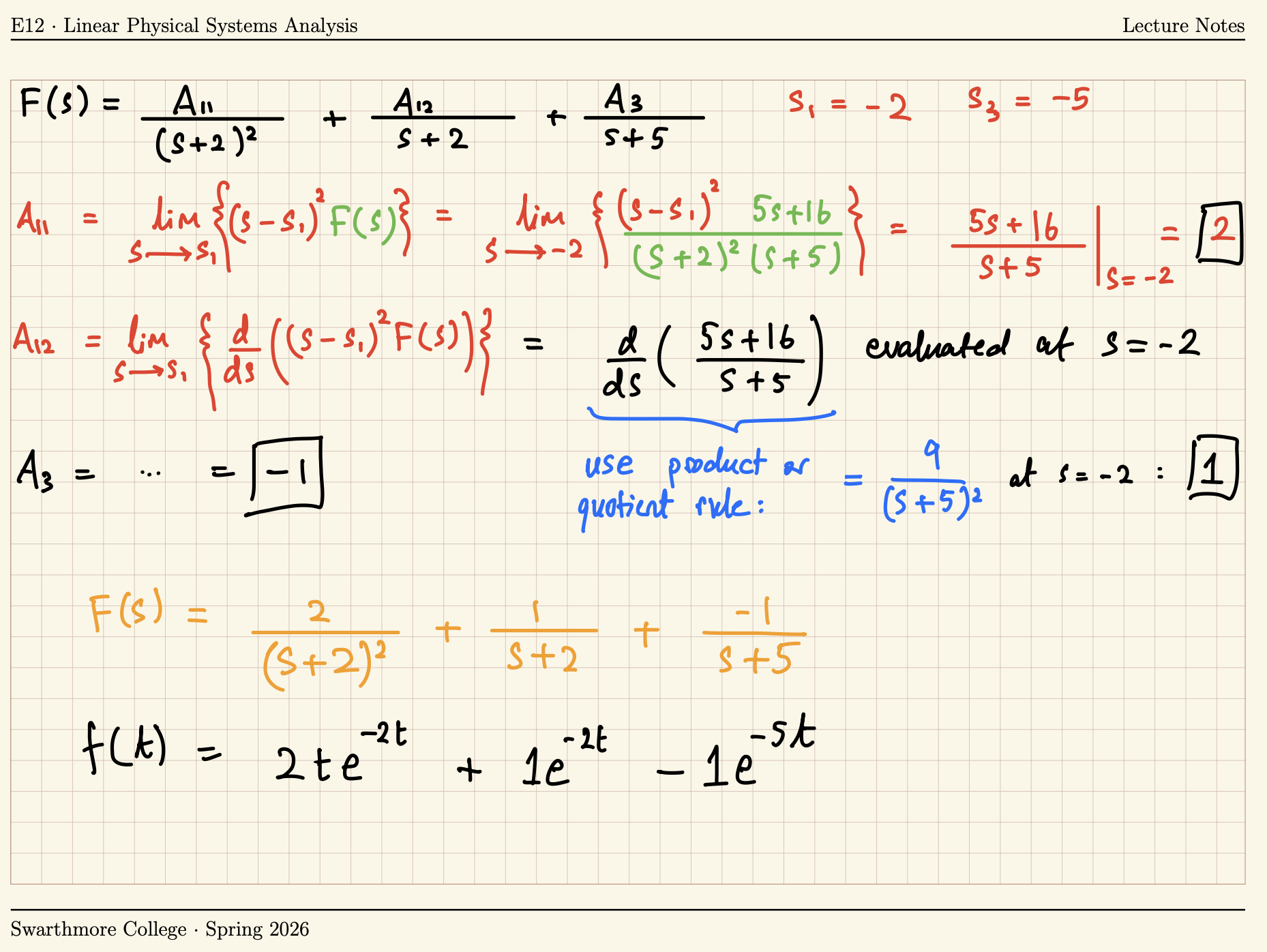
A similar formula can be derived for \(A_{12}\): \[A_{12} = \lim_{s\rightarrow s_1}\left( \frac{d}{ds} \left[ (s-s_1)^2 F(s)\right]\right)\]
Practice
Find the inverse Laplace Transform of the following function: \[F(s) = \frac{5s+16}{(s+2)^2 (s+5)}\]
Partial Fractions Expansion for Complex Poles
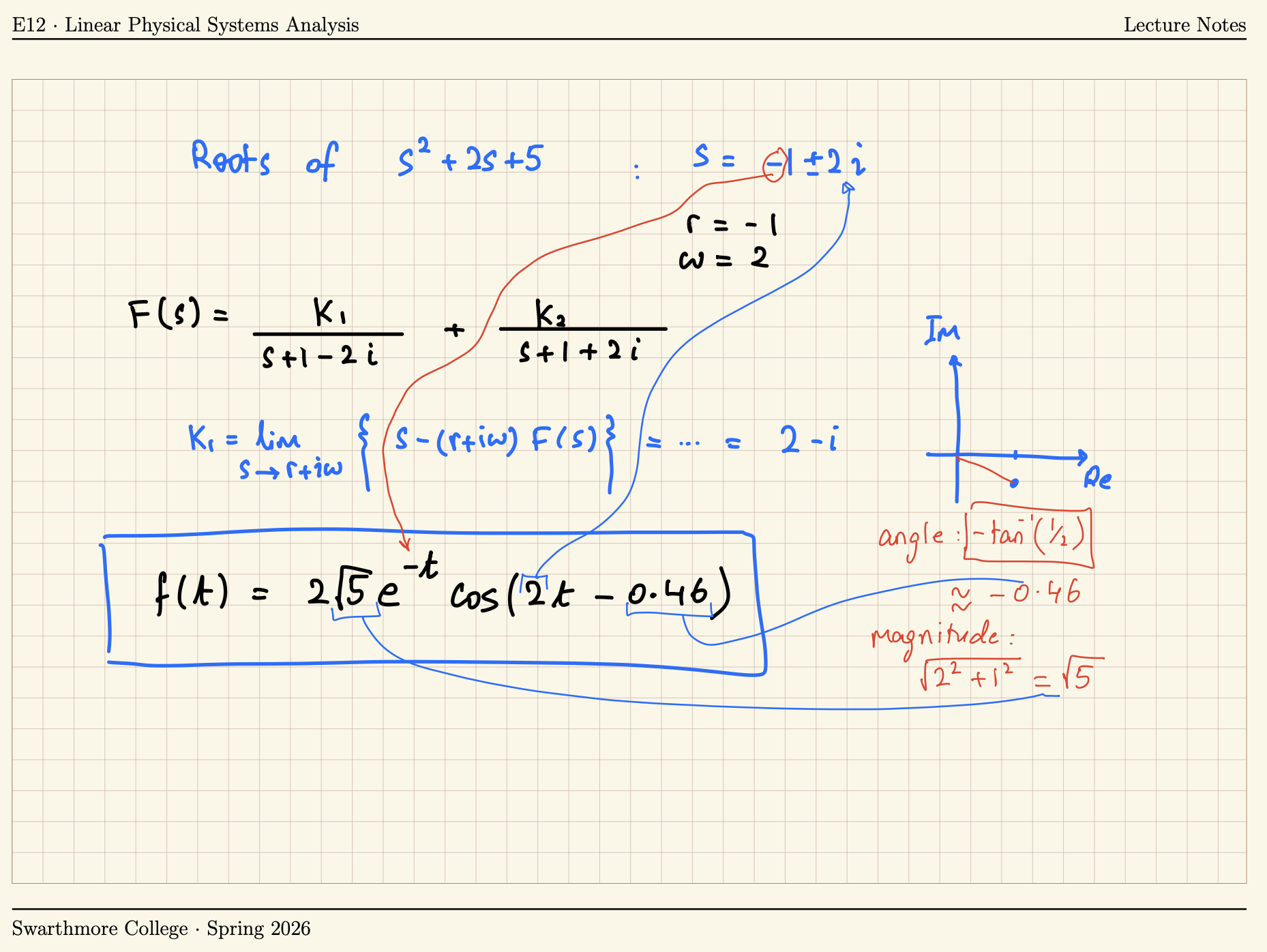
Consider \[F(s) = \frac{N(s)}{D(s)}\] where \(D(s)\) has two complex roots.
Then \[F(s) = \frac{Bs+C}{(s-(r+i\omega))(s-(r-i\omega))}\]
- It is possible to re-write \(F(s)\) as \[F(s) = \frac{K_1}{s-(r+i\omega)} + \frac{K_2}{s-(r-i\omega)}\]
- but \(K_1\) and \(K_2\) will have to be complex.
- We can apply the formula for the distinct-pole coefficients \(K_1\) and \(K_2\), i.e. \[ \begin{aligned} K_1 &= \lim_{s \rightarrow r+i\omega} \left[ (s-(r+i\omega))F(s) \right] \\ K_2 &= \lim_{s \rightarrow r-i\omega} \left[ (s-(r-i\omega))F(s) \right] \end{aligned} \]
- and this shows us that \(K_1\) and \(K_2\) are complex conjugates of each other.
- Thus, \[F(s) = \frac{K e^{i \phi}}{s-(r+i\omega)} + \frac{K e^{-i\phi}}{s-(r-i\omega)}\]
- which can be transformed back into the time domain as \[f(t) = Ke^{i \phi} e^{(r+i\omega)t} + Ke^{-i \phi} e^{(r-i\omega)t} \]
- which simplifies to \[K e^{rt} \left[ e^{i(\omega t + \phi)} + e^{-i(\omega t + \phi)} \right] \]
\[= 2K e^{rt} \underbrace{\left[ \frac{e^{i(\omega t + \phi)} + e^{-i(\omega t + \phi)}}{2} \right]}_{\cos (\omega t + \phi)}\]
- so we can write
\[f(t) = 2 K e^{rt} \cos( \omega t + \phi) \tag{4}\]
Alternate method
Write \(F(s)\) as \[\frac{Bs+C}{s^2 - 2 r s + r^2 + \omega^2} = \frac{Bs+C}{(s-r)^2+\omega^2}\]
and re-write its numerator so that there’s a factor of \(s-r\): \[F(s) = \frac{B(s-r) + C+rB}{(s-r)^2+\omega^2}\]
which can then be split apart into \[F(s) = B \frac{s-r}{(s-r)^2+\omega^2} + \left( \frac{C+rB}{\omega} \right) \frac{\omega}{(s-r)^2+\omega^2}\]
these are entries in the Laplace tables: \[F(s) = B \underbrace{\frac{s-r}{(s-r)^2+\omega^2}}_{\mathcal{L}[e^{rt} \cos \omega t]} + \left( \frac{C+rB}{\omega} \right) \underbrace{ \displaystyle \frac{\omega}{(s-r)^2+\omega^2}}_{\mathcal{L}[e^{rt} \sin \omega t]}\]
so in the time domain, we have
\[f(t) = B e^{rt} \cos \omega t + \left(\frac{C+rB}{\omega}\right) e^{rt} \sin \omega t \tag{5}\]
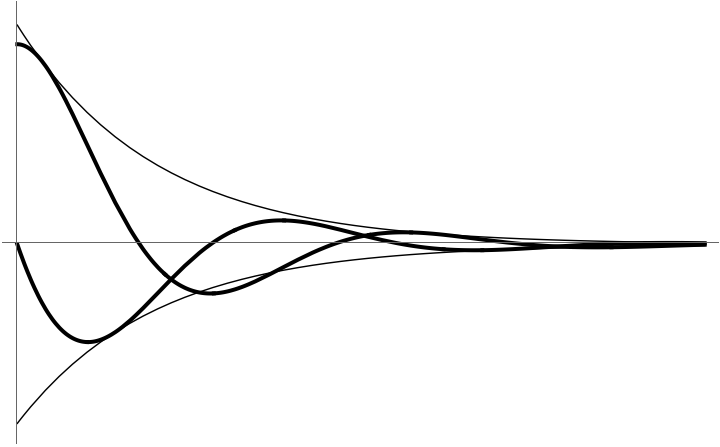
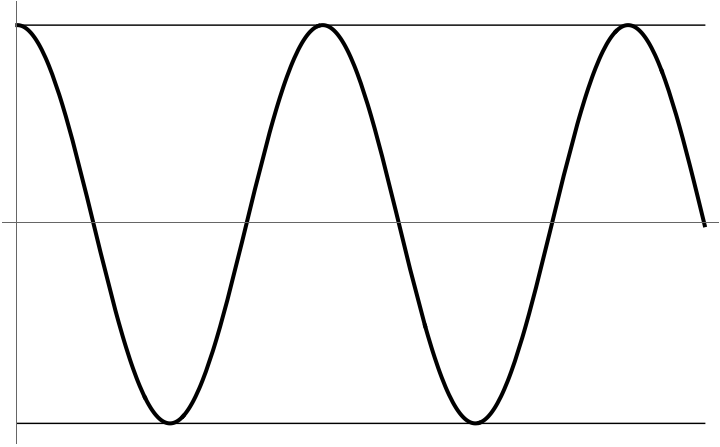
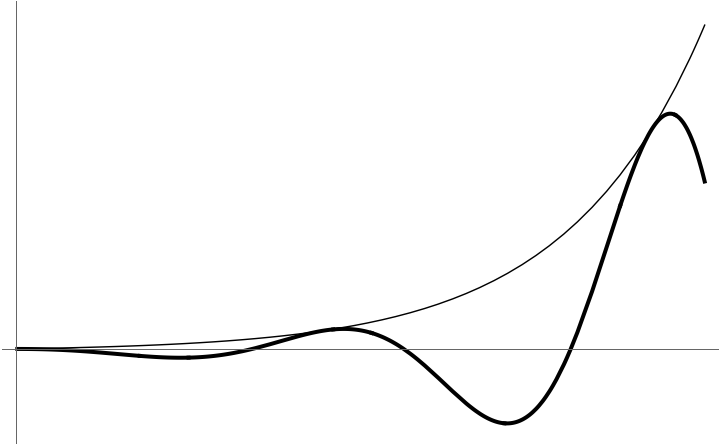
- Both Equation 4 and Equation 5 are equivalent ways of referring to the same phenomenon:
Practice
Find the inverse Laplace Transform of the following function: \[F(s) = \frac{4s+8}{s^2+2s+5}\]
Forced Response of 2nd order systems
| Input | \(f(t)\) | \(F(s)\) | Response \(X(s)\) | Response \(x(t)\) |
|---|---|---|---|---|
| Step |
\(b u_s(t)\) | \(\displaystyle \frac{b}{s}\) | \(\displaystyle \frac{b}{s} \frac{\omega_n^2}{s^2 + 2 \zeta \omega_n s + \omega_n^2}\) | \(\displaystyle \phantom{\frac{b}{a} \left( 1 - e^{-at} \right)}\) 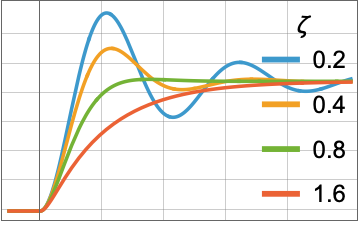 |
| Impulse |
\(A \delta(t)\) | \(A\) | \(A \displaystyle \frac{\omega_n^2}{s^2 + 2 \zeta \omega_n s + \omega_n^2}\) | \(\displaystyle \phantom{A e^{-at}}\) 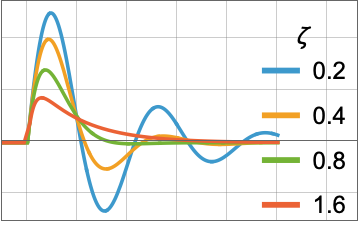 |
| Ramp |
\(u_s(t) \cdot c t\) | \(\displaystyle \frac{c}{s^2}\) | \(\displaystyle \left(\frac{c}{s^2}\right) \frac{\omega_n^2}{s^2 + 2 \zeta \omega_n s + \omega_n^2}\) | \(\displaystyle \phantom{\frac{c}{a^2} \left( e^{-at} - 1\right) + \frac{c}{a} t}\) 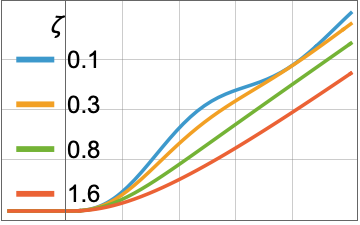 |
| Sinusoid |
\(u_s(t) \cdot \sin \omega t\) | \(\displaystyle \frac{\omega}{s^2+\omega^2}\) | \(\displaystyle \left(\frac{\omega}{s^2+\omega^2} \right) \frac{\omega_n^2}{s^2 + 2 \zeta \omega_n s + \omega_n^2}\) | 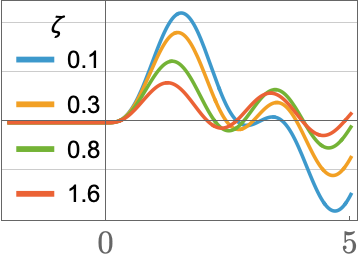 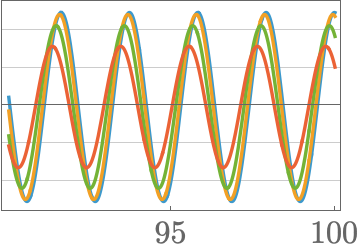 |