Problem Set 9 Solutions

ENGR 12, Spring 2026.

Solutions

1 Forced Response of First-order systems

Consider a single-input, single-output linear system whose transfer function is given by \[\frac{1}{4s+5}.\] We would like to determine the response of this system to an input given by the following function of time. \[ \begin{cases} 2+3t & t >0 \\ 0 & t \leq 0 \end{cases} \]

1.1 Frequency domain

Use the formulae for the coefficients of partial fractions, given in lecture 18, to determine the response in the frequency domain as the sum of three terms.

TipSolution

First, we note that the input \(f(t) = 2+3t\) in the time domain corresponds to \[F(s) = \frac{2}{s} + \frac{3}{s^2}\] in the frequency domain. Thus, \(X(s) = T(s)F(s)\) where \(T(s)\) is the system’s transfer function, \(X(s)\) the output and \(F(s)\) the input.

\[ \begin{aligned} X(s) &= \left( \frac{2}{s} + \frac{3}{s^2} \right) \frac{1}{4s+5} \\ &= \frac{2s+3}{s^2} \frac{1}{4s+5} = \frac{(2s+3)(1/4)}{s^2 (s+5/4)} \end{aligned} \]

Now, we also know that \(X(s)\) should be express-able as

\[ \frac{A_1}{s^2} + \frac{A_2}{s} + \frac{A_3}{s+5/4} \]

To find these coefficients, we use

\[ \begin{aligned} A_1 &= \lim_{s \rightarrow 0} \left[ s^2 X(s) \right] = \lim_{s \rightarrow 0} \left[ \frac{(2s+3)(1/4)}{s+5/4}\right] = \frac{3/4}{5/4} = 3/5 \\ A_2 &= \lim_{s \rightarrow 0} \left[ \frac{d}{ds} \left( s^2 X(s) \right) \right] = \frac{d}{ds} \left( \frac{1}{4} \frac{2s+3}{s+5/4} \right) \\ &= \lim_{s \rightarrow 0} \frac{1}{4} \left( -\frac{2s+3}{(s+5/4)^2} + \frac{2}{s+5/4} \right) \\ &= -\frac{2}{25} \\ A_3 &= \lim_{s \rightarrow -5/4} \left[ \frac{(2s+3)(1/4)}{s^2} \right] = \frac{2}{25} \end{aligned} \]

Thus, the forced response in the frequency domain is \[X(s) = \frac{3/5}{s^2} + \frac{-2/25}{s} + \frac{2/25}{s+5/4}\]
1.2 Time domain

Use the table of Laplace Transforms to determine the response as a function of time.

TipSolution

The forced response in the time domain is \[x(t) = \frac{2}{25} \left( e^{-5t/4} - 1\right) + \frac{3t}{5}\]

1.3 Steady-State vs Transient

  1. Write down the steady-state portion of the forced response, in the time domain and the frequency domain.
  2. Write down the transient portion of the forced response, in the time domain and the frequency domain.
TipSolution
  1. The steady-state portion is the part that remains over long periods of time, i.e. \[\frac{-2}{25} + \frac{3t}{5}\]
  2. The transient portion is the part that dies out, i.e., \[\frac{2}{25} e^{-5t/4}\]

1.4 MATLAB

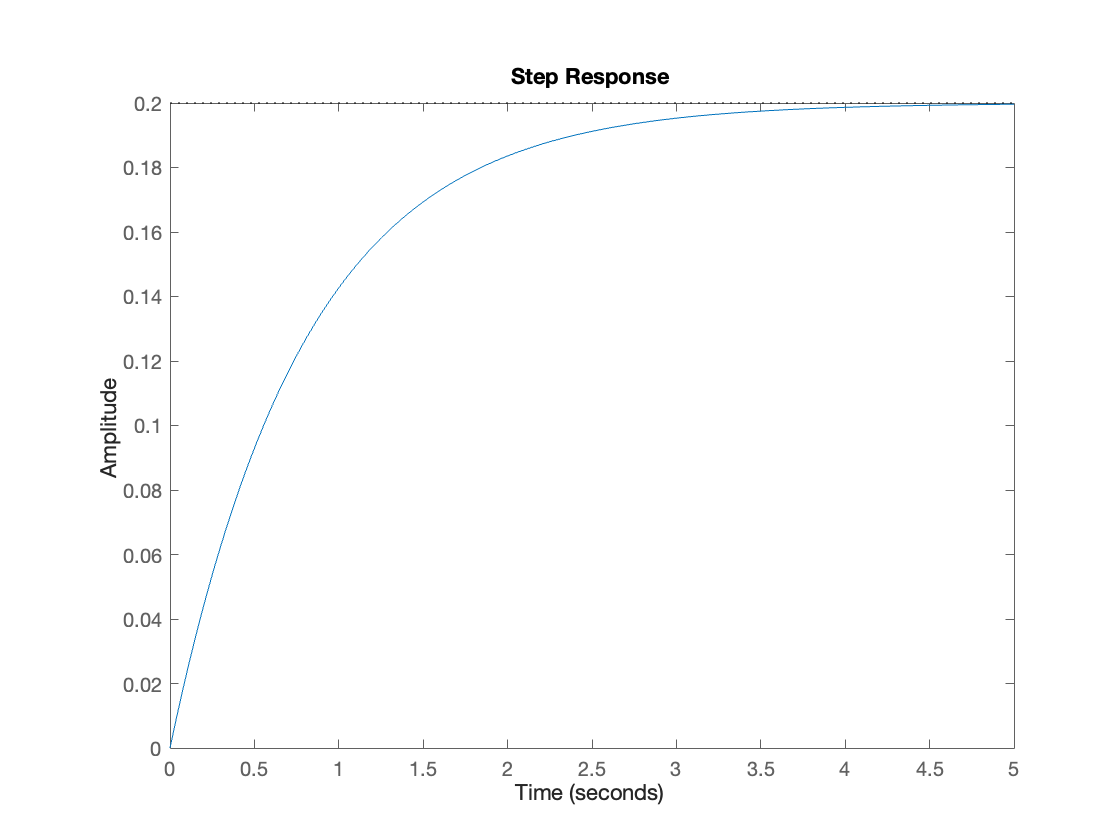
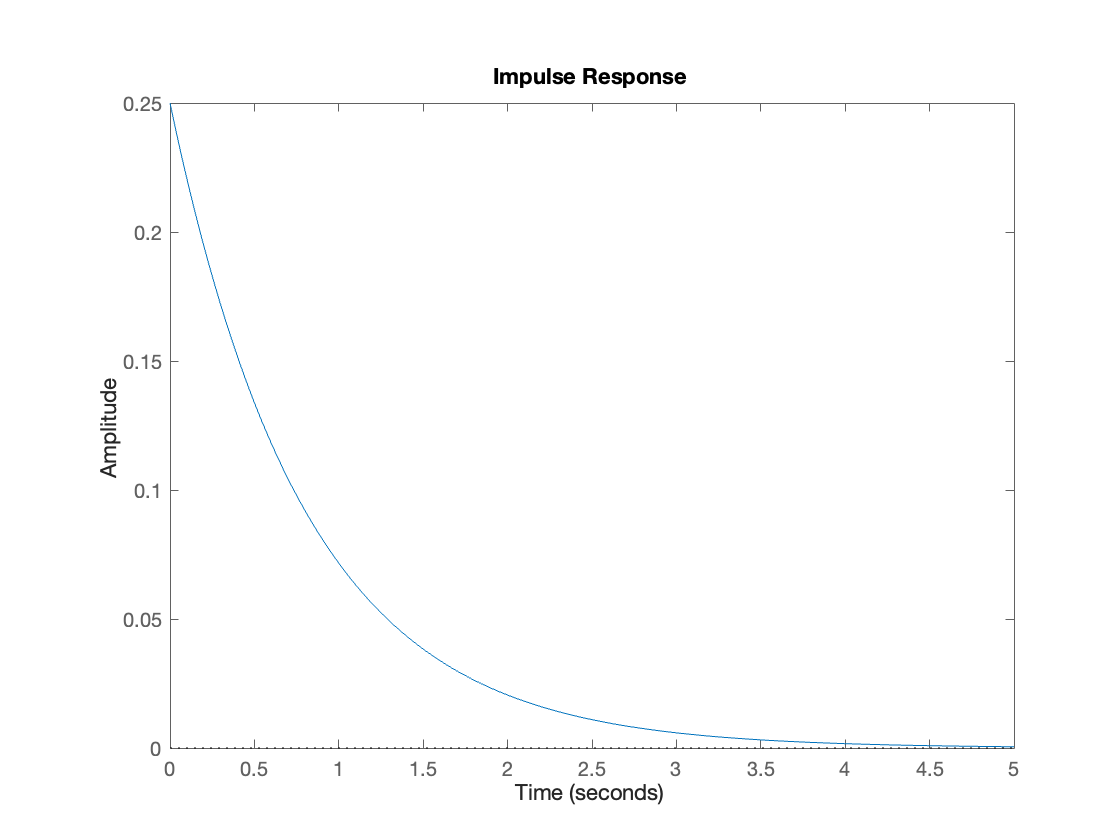
Use Matlab’s tf, step, and impulse functions to generate plots of this system’s step response and impulse response.

TipSolution

2 Second-order systems

Consider the system described by the block diagram shown below.

2.1 Underdamped case

If the system is underdamped, show that the poles of the transfer function are located at \[-\zeta \omega _n \pm i \omega_n \sqrt{(1-\zeta^2)} \]

TipSolution

The poles of the transfer function are located at the roots of the denominator polynomial. The denominator polynomial is \(s^2 + 2 \zeta \omega_n s + \omega_n^2\) and the roots of this polynomial, by the Quadratic Formula, are located at \[ \begin{aligned} s_{1,2} &= \frac{-2\zeta \omega_n \pm \sqrt{4 \zeta^2 \omega_n^2 - 4 \omega_n^2}}{2} \\ &= {-\zeta \omega_n \pm \omega_n \sqrt{\zeta^2-1}} \\ \text{underdamped} &\implies \zeta < 1 \\ & \implies \sqrt{\zeta^2-1} = i \underbrace{\sqrt{1-\zeta^2}}_{\in \, \mathbb{R}} \\ s_{1,2} &= -\zeta \omega _n \pm i \omega_n \sqrt{1-\zeta^2} \\ & \text{Q.E.D} \end{aligned} \]

2.2 Overdamped case

If the system is overdamped, find the poles of the transfer function in terms of \(\omega_n\) and \(\zeta\).

TipSolution

We repeat the analysis of problem Section 2.1 and this time, we use \(\zeta > 1\) instead of \(\zeta<1\). Thus, we get \[ \begin{aligned} s_{1,2} &= \frac{-2\zeta \omega_n \pm \sqrt{4 \zeta^2 \omega_n^2 - 4 \omega_n^2}}{2} \\ &= {-\zeta \omega_n \pm \omega_n \sqrt{\zeta^2-1}} \\ \text{overdamped} &\implies \zeta > 1 \\ & \implies \underbrace{\sqrt{\zeta^2-1}}_{\in \, \mathbb{R}} \\ s_{1,2} &= -\zeta \omega _n \pm \omega_n \sqrt{\zeta^2-1} \end{aligned} \]

2.3 Impulse Response

For the following parts, use \(\zeta = 2\) and \(\omega_n = 3\).

2.3.1 Frequency domain

Find an expression in terms of \(s\) for the impulse response of this system in the frequency domain. Leave your answer in terms of square roots, i.e., do not simplify, e.g., \(\sqrt{2}\) as \(1.41\).

TipHint #1

Your answer should be the sum of two fractions having the form \(\displaystyle \frac{a}{s-b}\).

TipSolution

The impulse response equals the transfer function. So, for a second order system with transfer function \[\frac{\omega_n^2}{s^2 + 2 \zeta \omega_n s + \omega_n^2}\] and \(\zeta = 2, \omega_n = 3\), the impulse response is \[\frac{9}{s^2+2\cdot 2 \cdot 3 s + 9} = \frac{9}{s^2+12s+9}\] and we know that the denominator can be written as the product of two factors \((s-s_1)(s-s_2)\) where both \(s_1\) and \(s_2\) are real (since it’s overdamped). The two roots are \[s_{1,2} =-6 \pm \sqrt{27}\] so we can write the impulse response as \[\frac{A}{s+6 +\sqrt{27}} + \frac{B}{s+6-\sqrt{27}}.\] To find out what \(A\) and \(B\) are, we can use the formulae from lecture 18: \[ \begin{aligned} A &= \lim_{s \rightarrow -6-\sqrt{27}} \left[ \left(s+6+\sqrt{27}\right)\left( \frac{9}{s^2+12s+9}\right) \right] \\ &= \lim_{s \rightarrow -6-\sqrt{27}} \left[ \cancel{\left(s+6+\sqrt{27}\right)}\left( \frac{9}{\cancel{(s+6+\sqrt{27})}(s+6-\sqrt{27})}\right) \right] \\ &= \lim_{s \rightarrow \color{red}{-6-\sqrt{27}}} \left[ \frac{9}{s+6-\sqrt{27}}\right] \\ &= \frac{9}{{\color{red}{-6-\sqrt{27}}}+6 - \sqrt{27}} = -\frac{9}{2\sqrt{27}} = -\frac{\sqrt{3}}{2} \end{aligned} \] Then we can apply a similar process for computing \(B\): \[ \begin{aligned} B &= \lim_{s \rightarrow -6+\sqrt{27}} \left[ \left(s+6-\sqrt{27}\right)\left( \frac{9}{s^2+12s+9}\right) \right] \\ &= \lim_{s \rightarrow -6+\sqrt{27}} \left[ \cancel{\left(s+6-\sqrt{27}\right)}\left( \frac{9}{(s+6+\sqrt{27})\cancel{(s+6-\sqrt{27})}}\right) \right] \\ &= \lim_{s \rightarrow \color{red}{-6+\sqrt{27}}} \left[ \frac{9}{s+6+\sqrt{27}}\right] \\ &= \frac{9}{{\color{red}{-6+\sqrt{27}}}+6 + \sqrt{27}} = +\frac{9}{2\sqrt{27}} = \frac{\sqrt{3}}{2} \end{aligned} \] Thus, the impulse response can be written as \[\frac{\sqrt{3}/2}{s+6-\sqrt{27}} - \frac{\sqrt{3}/2}{s+6+\sqrt{27}} \tag{1}\]

2.3.2 Time domain

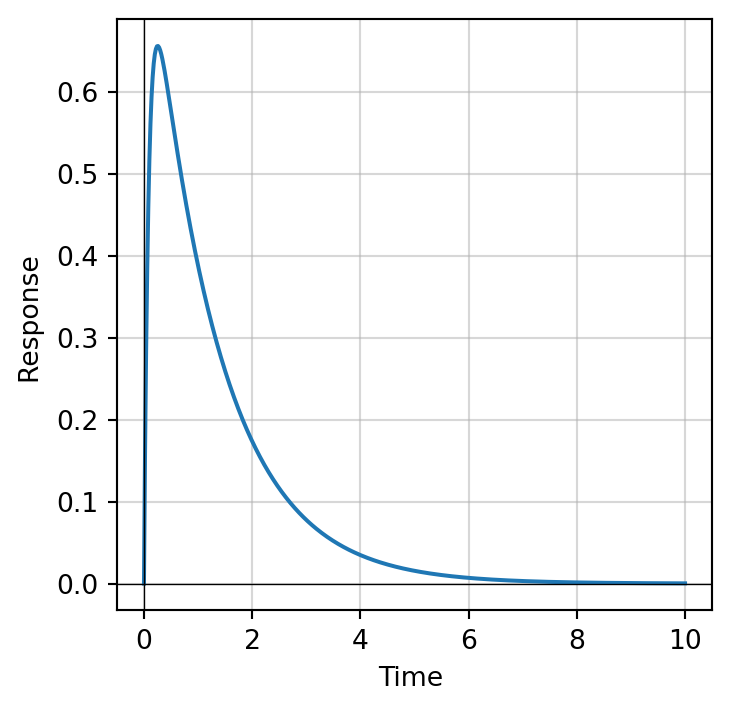
Use the table of Laplace Transforms to write down the impulse response of this system in the time domain, and use plotting software to generate a plot of this function against time.

TipSolution

Using the table of Laplace Transform pairs, we can write Equation 1 as \[\frac{\sqrt{3}}{2} e^{(-6+\sqrt{27})t} - \frac{\sqrt{3}}{2} e^{(-6-\sqrt{27})t}\]

import matplotlib.pyplot as plt
from numpy import sin, cos, linspace, logspace, sqrt, abs, log10, arctan, exp

t = linspace(0,10,500)
y = (sqrt(3)/2)*(exp((-6+sqrt(27))*t)) - (sqrt(3)/2)*(exp((-6-sqrt(27))*t))

fig, ax = plt.subplots(figsize=(4,4))

plt.plot(t,y)
plt.axhline(0,color="black",linewidth=0.5)
plt.axvline(0,color="black",linewidth=0.5)
plt.grid(True, which="both", ls="-", alpha=0.5)
ax.set_xlabel('Time ')
ax.set_ylabel('Response ')
plt.show()

3 Stability

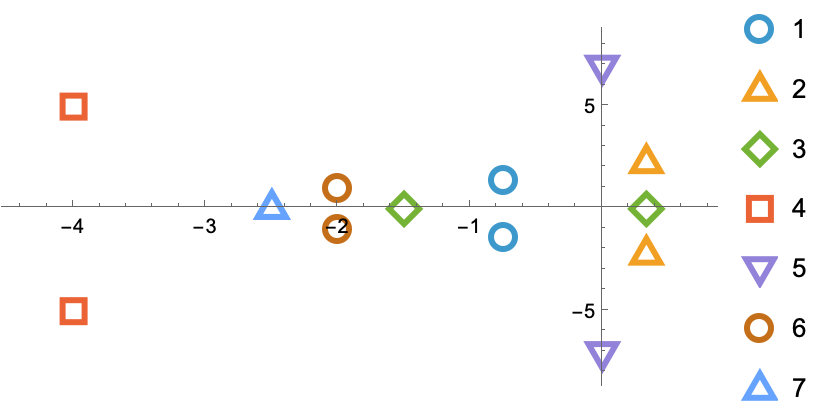
Decide which of the following systems are stable, unstable, or marginally stable. Write a short explanation of how you arrived at your conclusion for each, together with a plot on the complex plane of the roots of the characteristic polynomial of each system.

  1. A system described by the differential equation \[2 \ddot{x} + 3 \dot{x} + 5 x = 0\]
TipSolution

The roots of the characteristic polynomial \(2s^2+3s+5\) are \[s_{1,2} = -\frac{1}{4} \left(3 \pm i \sqrt{31} \right)\] and the real part is negative, so this is stable.

  1. A system described by the differential equation \[3 \ddot{x} - 2 \dot{x} + 2 x = 0\]
TipSolution

The roots of the characteristic polynomial \(3s^2-2s+2\) are \[s_{1,2} = \frac{1}{3} \left(1 \pm i \sqrt{5} \right)\] and the real part is positive, so this is unstable.

  1. A system described by the transfer function \[\frac{1}{(2s+3)(3s-1)}\]
TipSolution

The poles of this transfer function are \(s = -3/2\) and \(s = 1/3\). Since at least one of these two poles is positive, this system is unstable.

  1. A system described by the transfer function \[\frac{1}{(s+4)^2+5^2}\]
TipSolution

The poles of this transfer function are two complex conjugate numbers. To see what they are, we can use the ‘trick’ that the roots of the polynomial \((s-r)^2 + \omega^2\) are \(r \pm i \omega\). So the poles of this transfer function are \[s_{1,2} = -4 \pm 5 i\] and the real parts of these poles are negative. So this system is stable.

  1. A system described by the transfer function \[\frac{1}{s^2 + 7^2}\]
TipSolution

The poles of this transfer function are two purely imaginary numbers. Thus, this system is marginally stable (i.e., on the cusp between stable and unstable)

  1. A system described by the transfer function \[\frac{2s+3}{(s+2-i)(s+2+i)}\]
TipSolution

The poles of this transfer function are two complex numbers, and we can easily see that they are \[s_{1,2} = -2 \pm i.\] Thus, this system is stable since the real parts of the poles are negative.

  1. A system described by the differential equation \(2 \dot{x} + 5 x = 2t\)
TipSolution

The transfer function of this system has, in the denominator, the expression \(2s+5\). Thus, the (single) pole of the transfer function is \(s = -5/2\). (It does not matter what the numerator of the transfer function is.) Thus, this system is stable.

TipSolution Summary with a plot

We can summarize all this information in the following plot, which shows the poles of the transfer function plotted on the complex plane, with the real part on the horizontal axis and the imaginary part on the vertical axis.

4 Poles

4.1 Partial Fraction Expansions

Use the formulae derived in lecture 18 to determine the numerators of the following partial fraction expansions.

  1. \[\frac{1}{s^2(3s+4)} = \frac{A}{s} + \frac{B}{s^2} + \frac{C}{s+4/3}\]
TipSolution

\[ \begin{aligned} B &= \lim_{s \rightarrow 0} \left[ \cancel{s^2} \cdot \frac{1}{\cancel{s^2} (3s+4)}\right] \\ &= \frac{1}{4} \\ C &= \lim_{s \rightarrow -4/3} \left[ \cancel{s+4/3} \cdot \frac{1/3}{{s^2} \cancel{(s+4/3)}}\right] \\ &= \frac{1/3}{16/9} = \frac{3}{16} \\ A &= \lim_{s \rightarrow 0} \left[ \frac{d}{ds} \left( \cancel{(s-0)^2} \cdot \frac{1}{\cancel{s^2}(3s+4)}\right) \right] \\ &= \lim_{s \rightarrow 0} \left[ \frac{d}{ds} \left( \frac{1}{3s+4} \right) \right] \\ &= \lim_{s\rightarrow 0} \left[ - \frac{3}{(4+3s)^2}\right] \\ &= -\frac{3}{16} \end{aligned} \]

  1. \[\frac{1}{s^2+s+7} = \frac{A}{s-s_1} + \frac{B}{s-s_2}\] where you determine what \(s_1\) and \(s_2\) are as well as the numerators \(A\) and \(B\).
TipHint

\(A\) and \(B\) may be complex numbers, and if so, you should think about the best way to represent these complex numbers.

TipSolution

The poles are complex numbers, the roots of the polynomial \(s^2 + s + 7\), which are \(-\frac{1}{2} \pm \frac{3}{2} i \sqrt{3}\). So we can wriite the given expression as

\[\frac{A}{s+\frac{1}{2}- \frac{3}{2}i \sqrt{3}} + \frac{B}{s+\frac{1}{2}+ \frac{3}{2}i \sqrt{3}}\]

Further, we know that \(A\) and \(B\) are complex numbers. We also know that they are complex conjugates of each other. Let’s find one of them using the formula from lecture 18.

\[ \begin{aligned} A &= \lim_{s \rightarrow -\frac{1}{2}+ i \frac{3 \sqrt{3}}{2}} \left[ \displaystyle \cancel{\left( s-\left(-\frac{1}{2}+ \frac{3 \sqrt{3}i}{2} \right) \right)} \cdot \frac{1}{\cancel{\left( s-\left(-\frac{1}{2}+ \frac{3 \sqrt{3}i}{2} \right) \right)} \left( s-\left(-\frac{1}{2}- \frac{3 \sqrt{3}i}{2} \right) \right)} \right] \\ &= \lim_{s \rightarrow -\frac{1}{2}+ i \frac{3 \sqrt{3}}{2}} \left[ \frac{1}{\left( s-\left(-\frac{1}{2}- \frac{3 \sqrt{3}i}{2} \right) \right)} \right] \\ &= \lim_{s \rightarrow \color{red}{-\frac{1}{2}+ i \frac{3 \sqrt{3}}{2}}} \left[ \frac{1}{\left( {\color{red}{-\frac{1}{2}+ i \frac{3 \sqrt{3}}{2}}} -\left(-\frac{1}{2}- \frac{3 \sqrt{3}i}{2} \right) \right)} \right] \\ &= \frac{1}{3\sqrt{3}i} \\ &= \frac{1}{3\sqrt{3}i} \frac{\sqrt{3}i}{\sqrt{3}i} = - \frac{\sqrt{3}i}{9} \end{aligned} \] and since \(B\) is its complex conjugate, we have \[B = + \frac{\sqrt{3}i}{9}.\]

So the expression we are looking for is

\[\frac{1}{s^2+s+7} = -\frac{\sqrt{3}i/9}{s+\frac{1}{2} - \frac{3\sqrt{3}i}{2}} + \frac{\sqrt{3}i/9}{s+\frac{1}{2} + \frac{3\sqrt{3}i}{2}}\]

4.2 Inverse Laplace Transform

Use the procedure from lecture 18 to determine the inverse Laplace transform of the following functions. Your answer should be a function of time.

  1. For the following function \[F(s) = \frac{2s-3}{\left(s+\frac{1}{2}\right)^2 + 27},\] find \(f(t)\) in terms of a function that uses both \(\sin\) and \(\cos\).
TipSolution

Let’s break up the function into two parts: \[ F(s) = \frac{2s-3}{\left(s+\frac{1}{2}\right)^2 + 27} = A \left( \frac{s+1/2}{\left(s+\frac{1}{2}\right)^2 + 27} \right)+ B \left( \frac{\sqrt{27}}{\left(s+\frac{1}{2}\right)^2 + (\sqrt{27})^2} \right) \]

Now, \(Bs+C = B(s-r) + C + rB\)

Now, notice that \(2s-3 = 2(s+1/2) -3 + 2(-1/2))\) and so we can re-write \(F(s)\) as follows:

\[ F(s) = 2\frac{(s+1/2)}{\left(s+\frac{1}{2}\right)^2 + 27} + \left( \frac{-3 + 2(-1/2)}{\sqrt{27}} \right) \cdot \frac{\sqrt{27}}{\left(s+\frac{1}{2}\right)^2 + 27} \]

Now, these terms are the familiar cosine and sine terms from the Laplace Transforms table. So we can write

\[ \begin{aligned} F(s) &= 2\underbrace{\frac{(s+1/2)}{\left(s+\frac{1}{2}\right)^2 + \sqrt{27}^2}}_{\mathcal{L}^{} \left[ e^{-t/2} \cos \sqrt{27}t \right]} + \left( \frac{-3 + 2(-1/2)}{\sqrt{27}} \right) \cdot \underbrace{\frac{\sqrt{27}}{\left(s+\frac{1}{2}\right)^2 + \sqrt{27}^2}}_{\mathcal{L}^{}\left[ e^{-t/2} \sin \sqrt{27} t \right]} \\ \implies f(t) &= 2 e^{-t/2} \cos \sqrt{27}t -\frac{4 \sqrt{3}}{9} e^{-t/2} \sin \sqrt{27}t \\ &= \frac{2\sqrt{3}}{9} e^{-t/2} \left( \sqrt{27} \cos \sqrt{27} t - 2 \sin \sqrt{27} t\right) \end{aligned} \]

  1. For the following function \[F(s) = \frac{1}{s^2+2s+3},\] find \(f(t)\) in terms of a function that uses \(\sin\) and does not use \(\cos\).
TipSolution

The poles of \(F(s)\) are located at \(s_{1,2} = -1 \pm i\sqrt{2}\). So we can write \(F(s)\) as \[F(s) = \frac{1}{(s+1 - i \sqrt{2})(s+1 + i \sqrt{2})}\] which is also equal to \[F(s) = \frac{1}{(s+1)^2 + \sqrt{2}^2} = \frac{1}{\sqrt{2}} \left( \frac{\sqrt{2}}{(s+1)^2 + \sqrt{2}^2} \right)\] and the term in parantheses is familiar to us from the Laplace Transform Pairs table. We can say that \[\mathcal{L}^{-1} \left[ \frac{\sqrt{2}}{(s+1)^2 + \sqrt{2}^2} \right] = e^{-t} \sin \sqrt{2}t \]

so \[f(t) = \mathcal{L}^{-1} \left[ F(s)\right] = \frac{1}{\sqrt{2}} e^{-t} \sin \sqrt{2}t\]