Lecture 27
E12 Linear Physical Systems Analysis
End of semester plans
- Final Exam Sunday night May 10(😭)
- Review session TBD, next week
- Homework 13 due Monday, May 04
- In-class assignment Thursday, Apr 30
Plan for Thursday
- In class
- Groups of up to 3 allowed (but not required)
- Submission is still individual
- Duration: Approx. 1 hour
- Work on paper provided
- Singer 034/035
- Resources:
- Can access course website
- Cannot access any other website
- No calculators or calculator programs!!
- Grade weightage TBD; minimum equal to 1 HW, maximum ?
Analyzing a second-order linear system
A system is governed by the differential equation
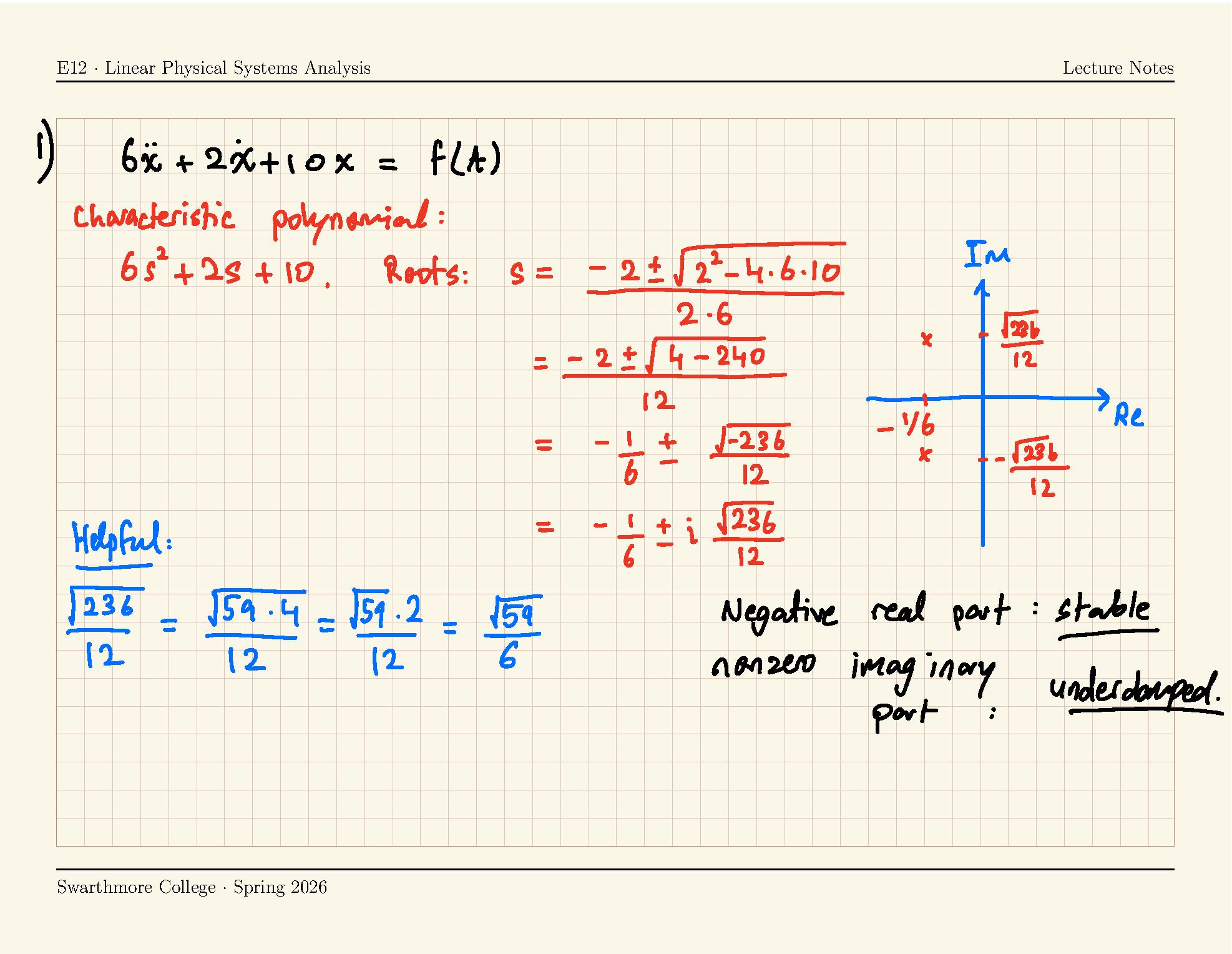
\[6 \ddot{x} + 2 \dot{x} + 10 x = f(t), \tag{1}\]
where \(x(t)\) is its output and \(f(t)\) its input.
- Make a sketch of the roots of the characteristic polynomial on the complex plane. Then, use your sketch to determine if this system is stable/unstable and overdamped/underdamped/critically damped.
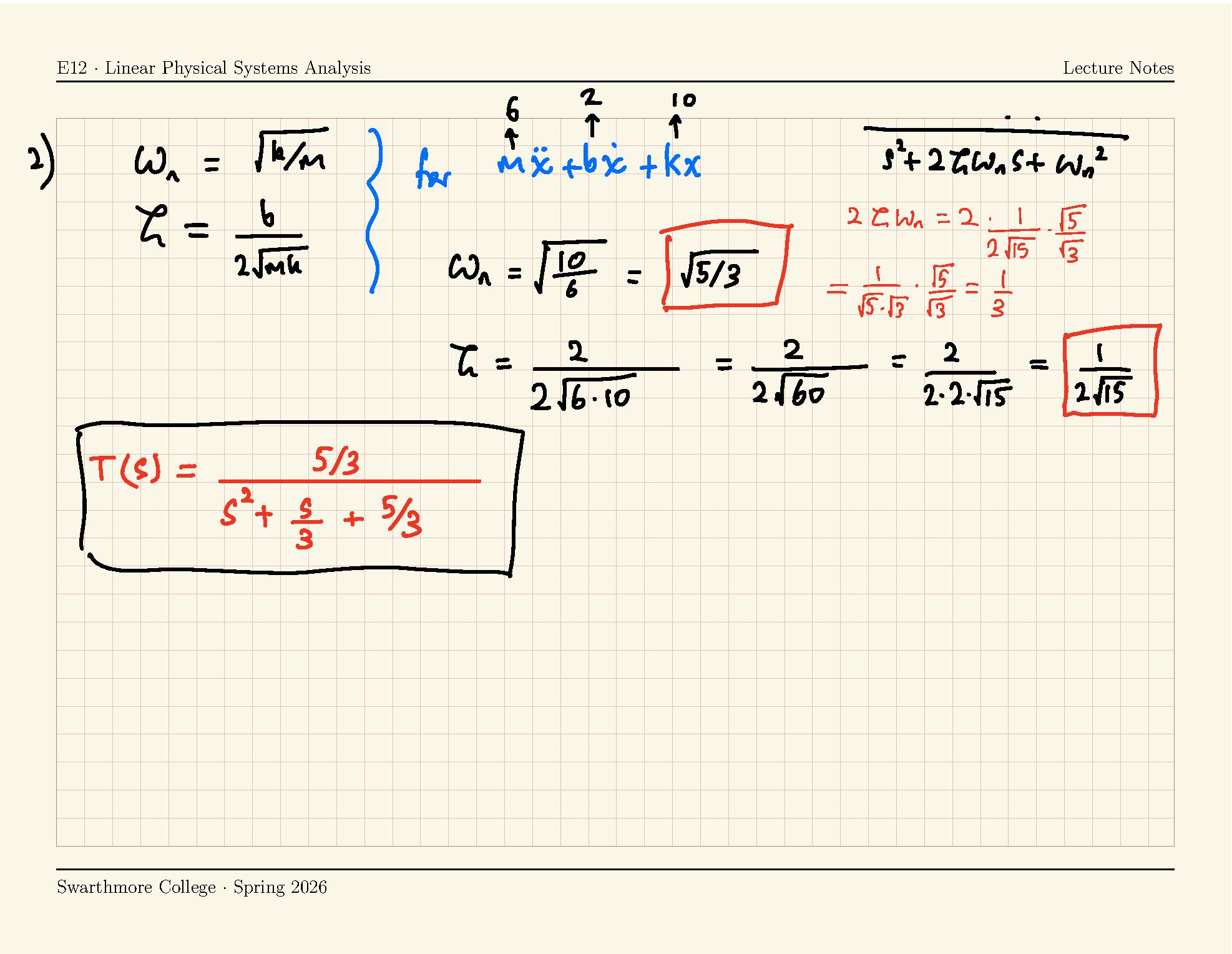
- Using the standard form \[T(s) = \frac{\omega_n^2}{s^2 + 2 \zeta \omega_n s + \omega_n^2}, \tag{2}\] find the transfer function \(T(s)\) for this system.
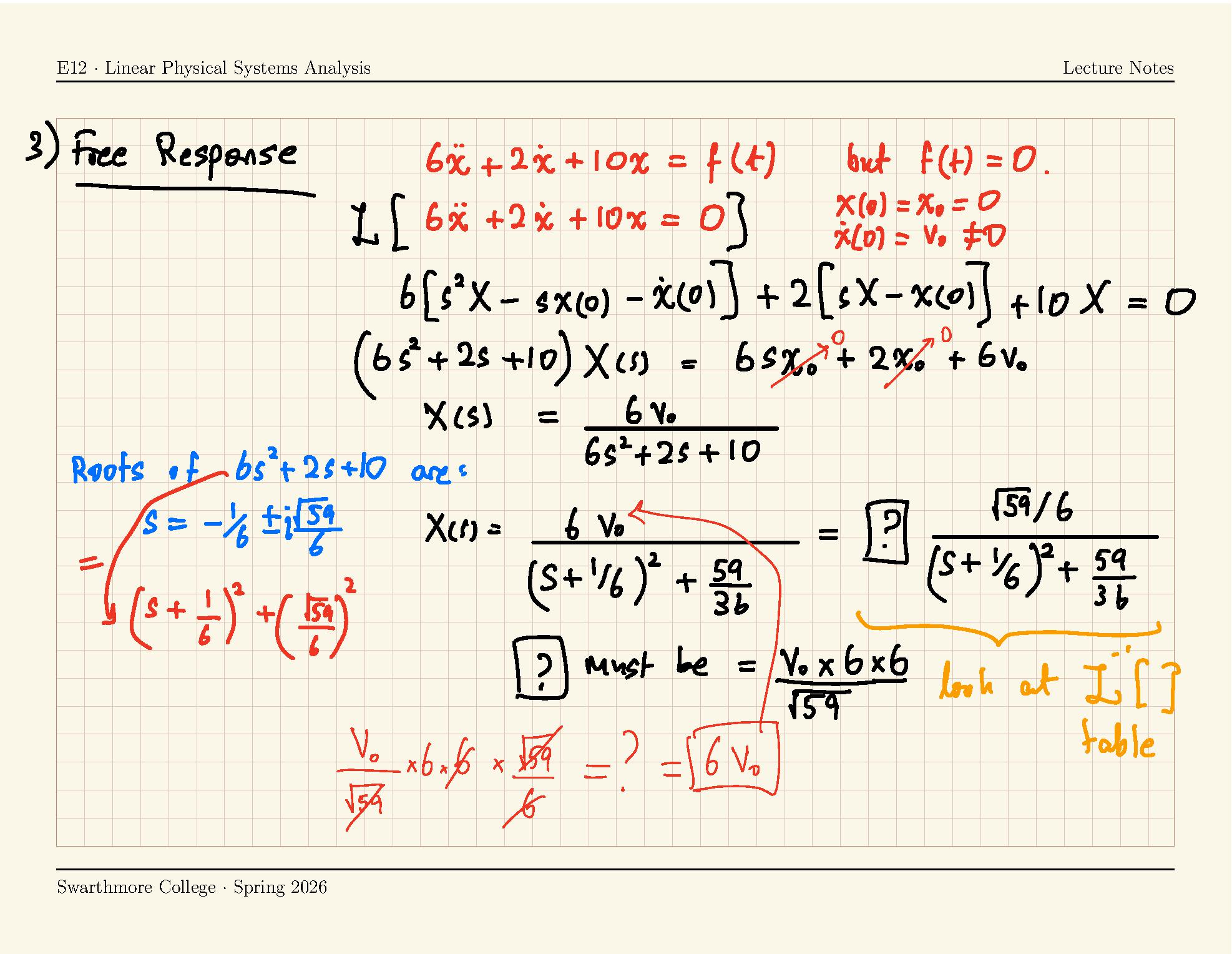
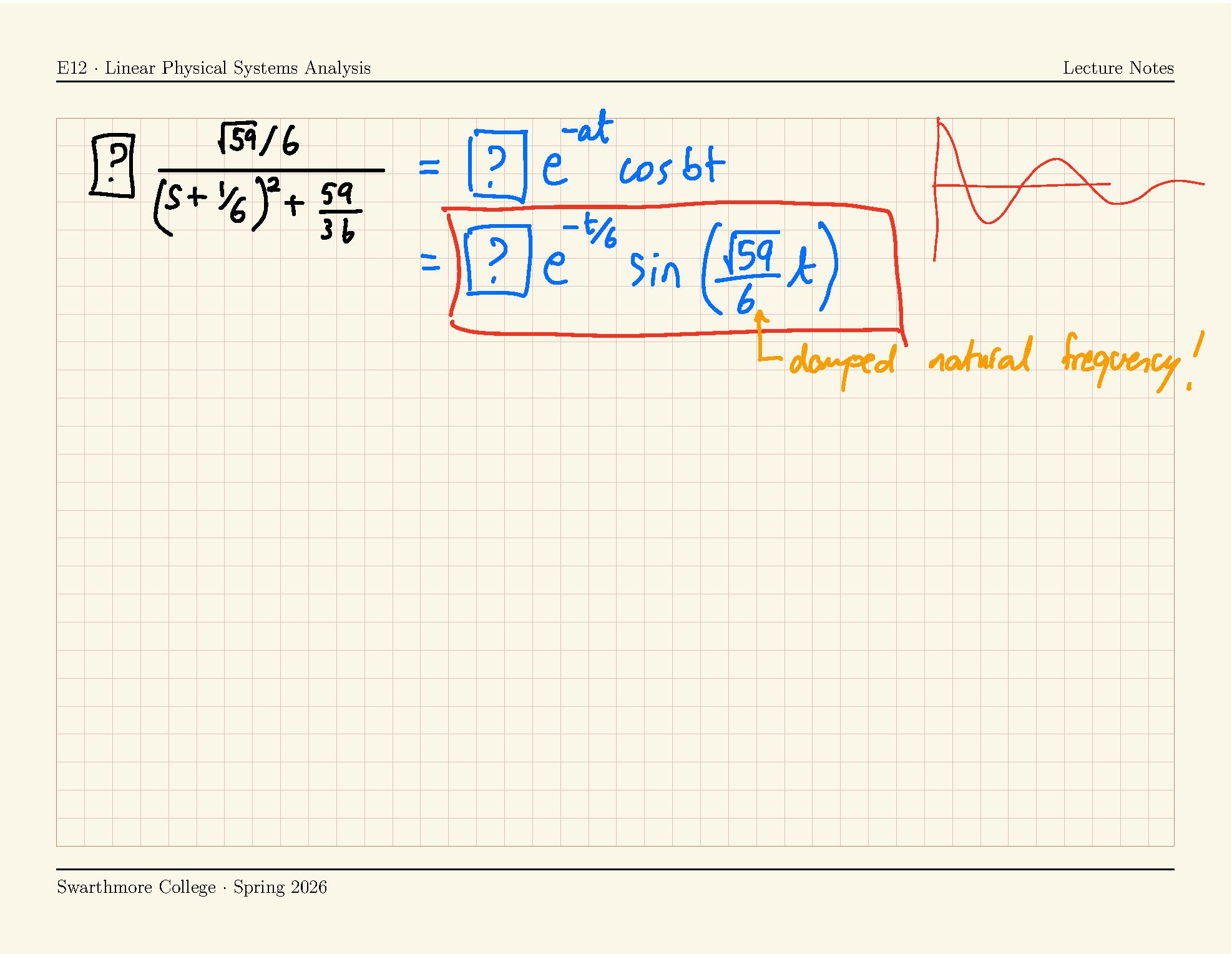
- The free response of this system if \(x(0)=0\) and \(\dot{x}(0)=v_0\), a constant. Give your answer in the time domain as a mathematical expression in terms of \(t\). For this question, start by taking the Laplace Transform of Equation 1.
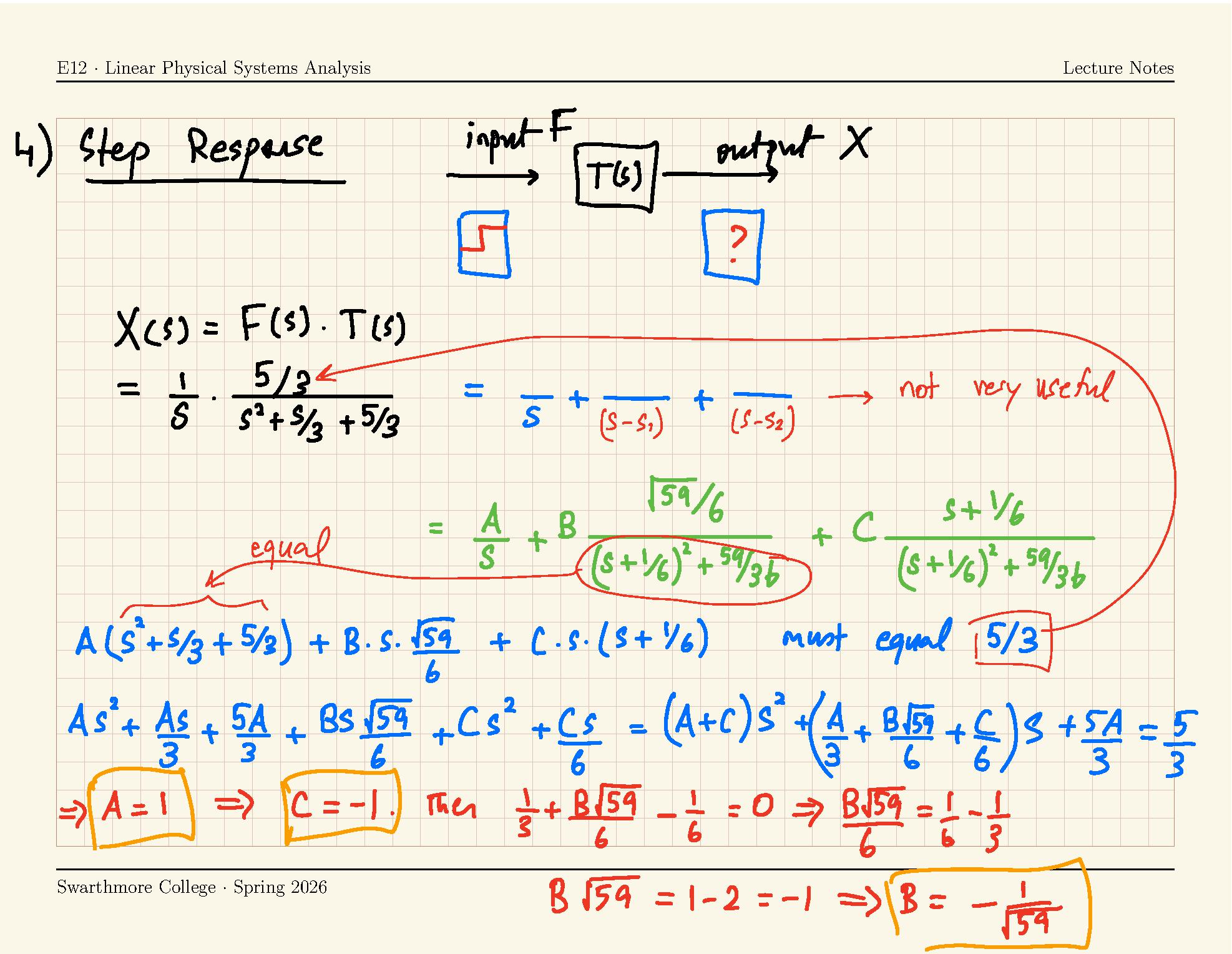
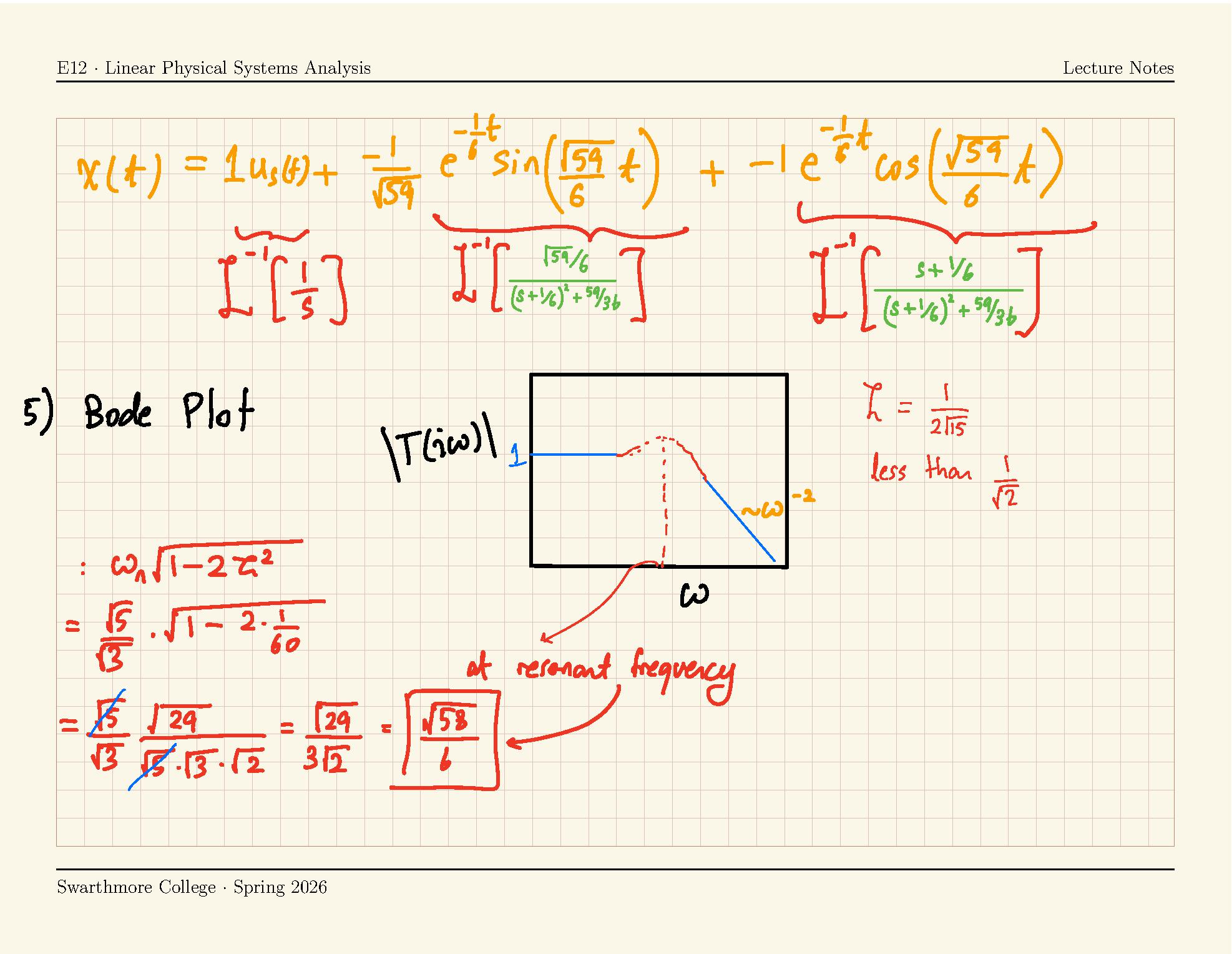
- The step response of this system. Give your answer in the time domain as a mathematical expression in terms of \(t\). For this quesiton, use the transfer function \(T(s)\) from Equation 2.
- Sketch the (magnitude) Bode plot for the system using Equation 2.
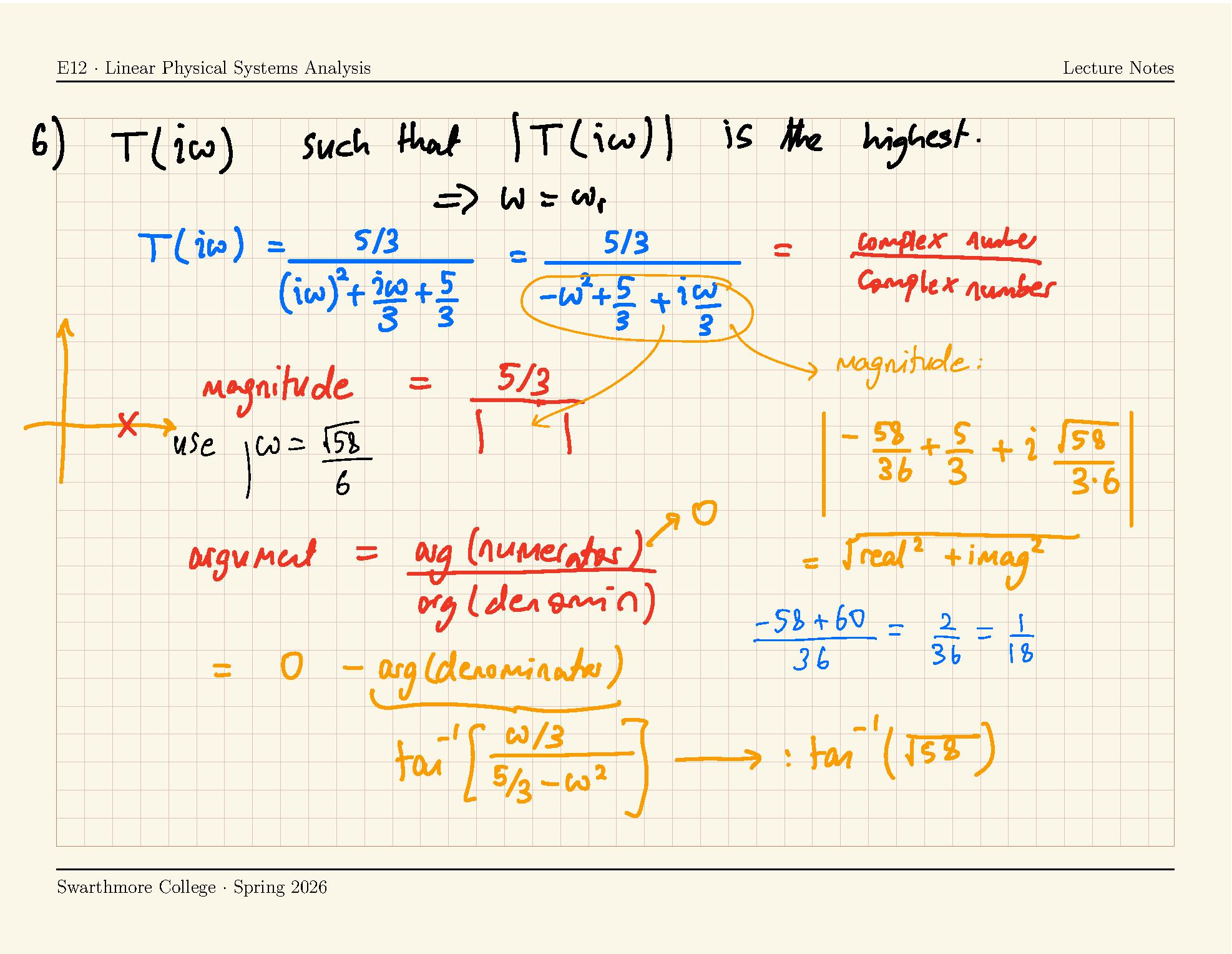
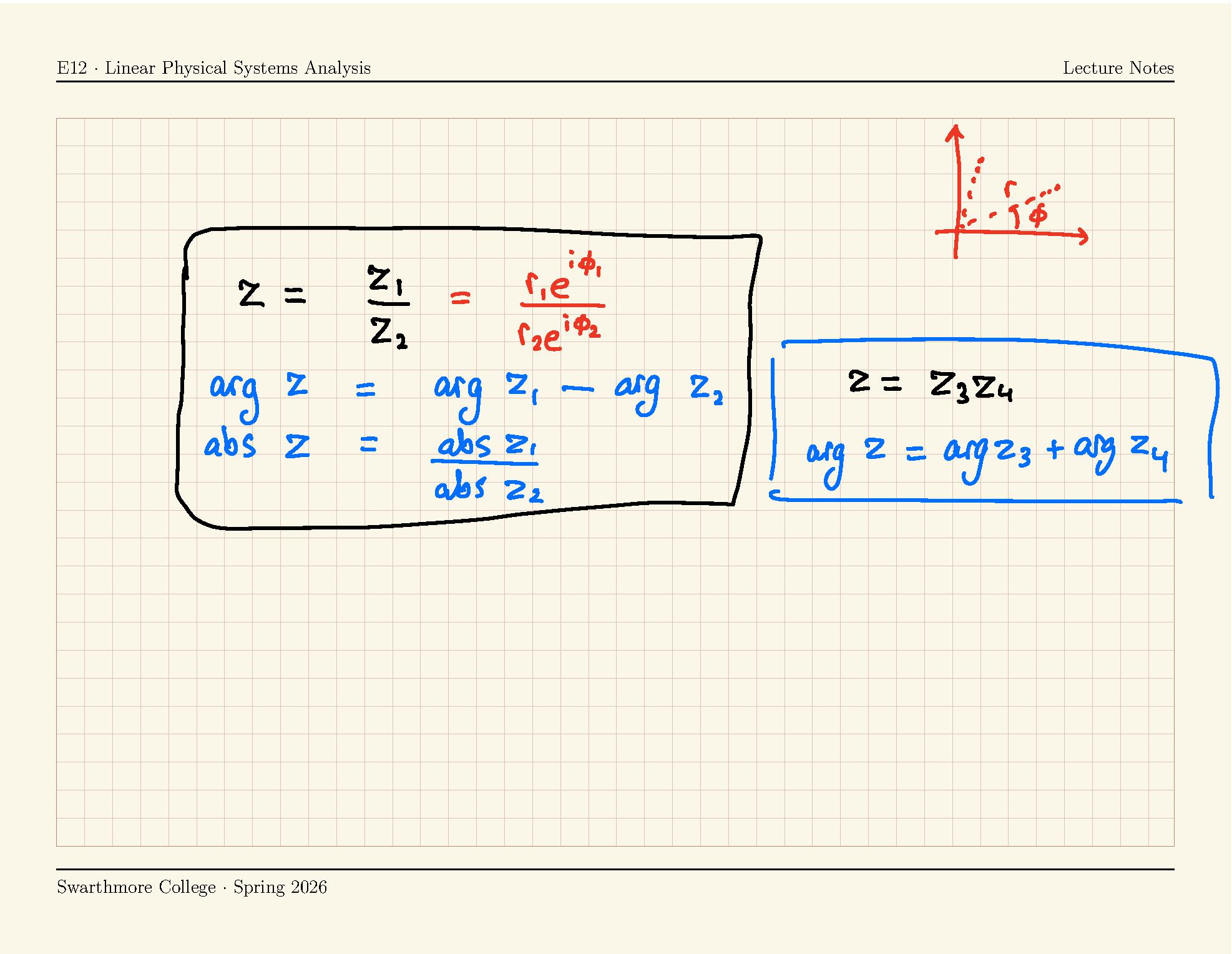
- If \(T(s)\) is subjected to a sinusoidal input with a frequency of our choice and a magnitude of unity, determine the maximum possible magnitude and the coresponding phase shift in radians (relative to the input) of the steady-state output of this system. For full points, give your answers as exact numbers using square roots where necessary.
In-class notes
In-class notes
In-class notes
In-class notes
In-class notes
In-class notes
In-class notes
In-class notes