Problem Set 14: Answer Key
ENGR 12, Spring 2026.
Tasks
In this assignment, you will analyze a system defined by the following differential equation \[\boxed{2 \ddot{x} + 7 \dot{x} + 3x = f(t)} \tag{1}\]
- Roots of the characteristic polynomial 2) Transfer Function 3) Step response 4) Impulse response 5) Bode plot 6) Amplitude and Phase Shift
Solutions
- Plot the roots of the characteristic polynomial of Equation 1 on the following set of axes. Then, determine if this system is stable or unstable and whether it is underdamped, overdamped, or critically damped.
We notice that the characteristic equation is \(2s^2+7s+3=0\). Using the quadratic formula, we find \[ \begin{aligned} s &= \frac{-7 \pm \sqrt{7^2-4\cdot 2 \cdot 3}}{2 \cdot 2} \\ &= -\frac{7}{4} \pm \frac{\sqrt{49-24}}{4} \\ &= -\frac{7}{4} \pm \frac{5}{4} \\ &= -\frac{1}{2} \quad \text{or} \quad -3 \end{aligned} \]
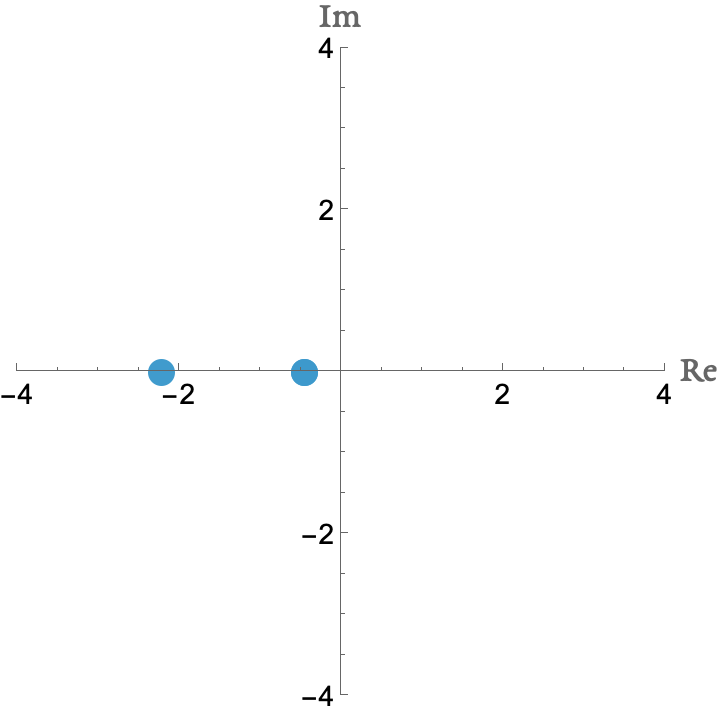
So the system is stable and since the roots are real, it’s overdamped. We can verify this by calculating the damping ratio \[\zeta = \frac{7}{2 \sqrt{2 \cdot 3}} = \frac{7}{2 \sqrt{6}} = \frac{7\sqrt{6}}{12}.\] This number is greater than one (since \(\sqrt{4} < \sqrt{6} < \sqrt{9}\), we know that \(2 < \sqrt{6} < 3\)) and so \(\frac{7 \sqrt{6}}{12} > 1\) and the system is overdamped.
- Write down the transfer function of this system, where \(F(s)\) is the input and \(X(s)\) is the output. Do not use any other expression for the transfer function of second-order systems that you may be aware of; deduce the transfer function directly from Equation 1.
Applying the Laplace Transform to Equation 1, we find \[ \begin{aligned} 2 s^2 X(s) + 7 s X(s) + 3 X(s) &= F(s) \\ \implies \frac{X(s)}{F(s)} &= \frac{1}{2s^2+7s+3} \end{aligned}\]
It will also be convenient to use the following form:
\[ \begin{aligned} \frac{X(s)}{F(s)} &= \frac{1/2}{(s+3)(s+1/2)} \end{aligned}\]
- Find the unit step response of this system, and give your answer as a function of time.
The Laplace Transform of a step function is \(\frac{1}{s}\). The response we are looking for has the form \[X(s) = T(s) F(s)\] where \(T\) is the transfer function and \(F\) the input. So we have
\[ \begin{aligned} X(s) &= \frac{1}{s} \frac{1/2}{(s+3)(s+1/2)} \\ &= \frac{A}{s} + \frac{B}{s+3} + \frac{C}{s+1/2} \end{aligned} \]
where \(A\), \(B\) and \(C\) are constants to be found. To determine their values, we multiply the fractions to get a common denominator:
\[ \begin{aligned} \frac{1}{s} \frac{1/2}{(s+3)(s+1/2)} &= \frac{A(s+3)(s+1/2) + B(s)(s+1/2) + C(s)(s+3)}{s(s+3)(s+1/2)} \\ \implies As^2 + 3As + As/2 + 3A/2 + B s^2 &+ Bs/2 + Cs^2 + 3Cs = 1/2 \end{aligned} \]
and we can collect terms with powers \(s^2\), \(s^1\) and \(s^0\):
\[ \begin{aligned} \frac{3A}{2} = \frac{1}{2} \implies A &= \frac{1}{3} \\ 3A + \frac{A}{2} + \frac{B}{2} + 3C &= 0 \\ A + B + C &= 0 \\ \end{aligned} \]
We can see that \(\displaystyle B = - C - \frac{1}{3}\) and so
\[ \begin{aligned} \frac{7}{2} \cdot \frac{1}{3} + \frac{1}{2} \left( -C - \frac{1}{3} \right) + 3 C &= 0 \\ \implies \frac{7}{6} - \frac{C}{2} - \frac{1}{6} + 3 C &= 0 \\ \frac{5}{2}C + 1 = 0 \implies C &= -\frac{2}{5} \end{aligned} \]
So in the frequency domain we have that \[X(s) = \frac{1/3}{s} + \frac{1/15}{s+3} + \frac{-2}{s+1/2}\]
and from the table of Laplace Transforms, we find that
\[\boxed{x(t) = \frac{1}{3} u_s(t) + \frac{1}{15} e^{-3t} - \frac{2}{5} e^{-t/2}}\]
- Find the unit impulse response of this system, and give your answer as a function of time.
The Laplace Transform of an impulse function is \(1\). So, the response we are looking for has the form \[X(s) = T(s) F(s)\] where \(T\) is the transfer function and \(F\) the input. So we have
\[ \begin{aligned} X(s) &= 1 \frac{1/2}{(s+3)(s+1/2)} \\ &= \frac{A}{s+3} + \frac{B}{s+1/2} \\ &= \implies A(s+1/2) + B(s+3) = \frac{1}{2} \\ As + Bs + \frac{A}{2} + 3B &= \frac{1}{2} \\ &\implies A + B = 0, \quad \frac{A}{2} + 3B = \frac{1}{2} \\ &\implies 3B - \frac{B}{2} = \frac{1}{2} \\ \frac{5B}{2} &= \frac{1}{2} \implies B = \frac{1}{5} \\ \implies A &= -\frac{1}{5} \end{aligned} \]
So the impulse response in the frequency domain is \[X(s) = \frac{-1/5}{s+3} + \frac{1/5}{s+1/2}\]
and in the time domain it’s \[\boxed{x(t) = \frac{1}{5} e^{-t/2} - \frac{1}{5} e^{-3t}}\]
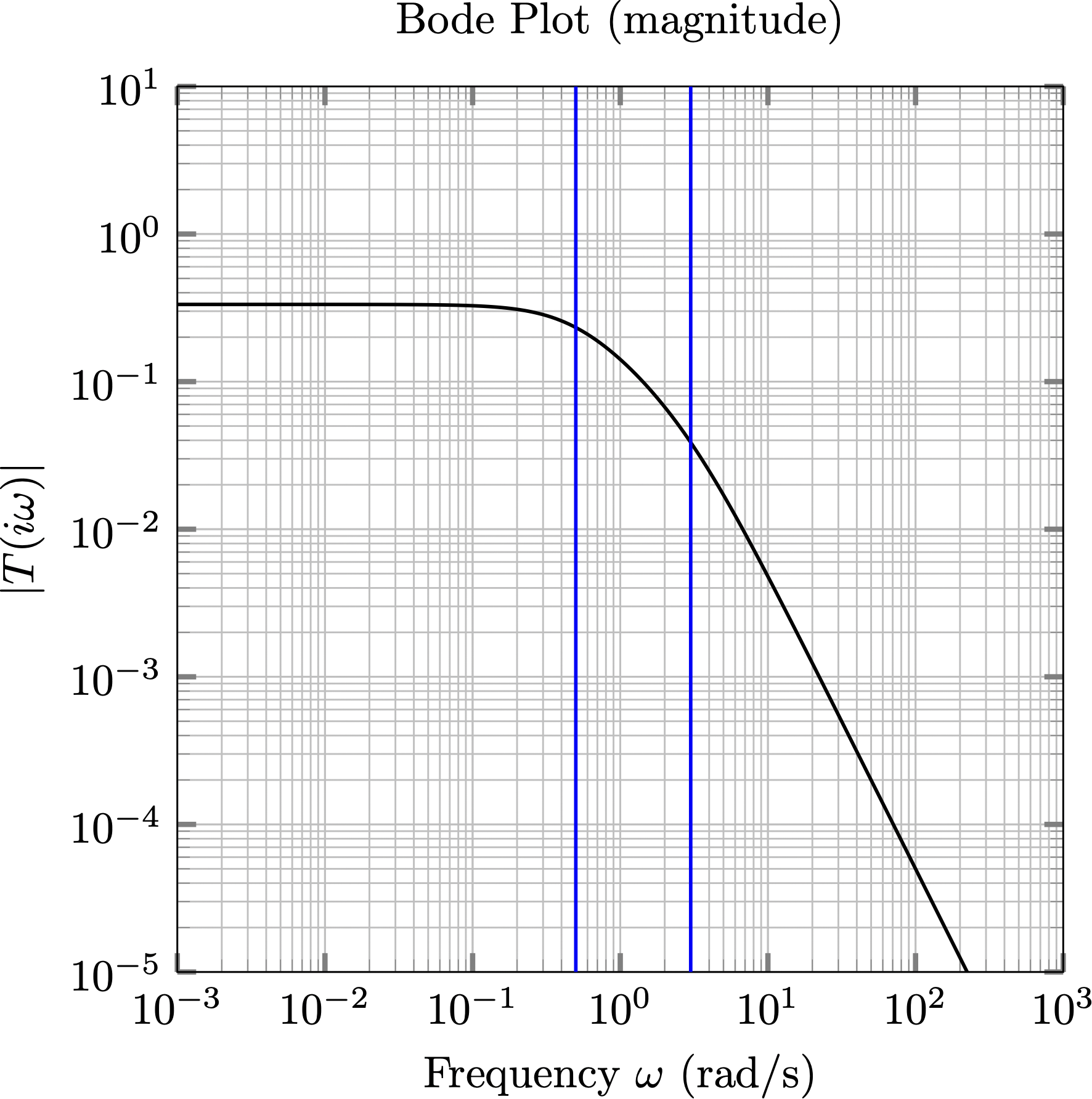
- Make a quantitatively accurate sketch, by hand, of the Bode plot for this system, and draw vertical lines showing the corner frequencies.
We note that the Bode plot should show a gain of
\[ |T(0)| = \left| \frac{1/2}{(0+3)(0+1/2)} \right | = \frac{1/2}{3/2} = \frac{1}{3} \]
when the input frequency is zero. We then add two corner frequencies, one at \(\omega = 1/2\) and one at \(\omega = 3\), indicated by blue vertical lines.
- If the system is subjected to an input \(f(t) = \sin t\), determine a mathematical expression for the output \(x(t)\) after it has reached steady-state.
We need to find the amplitude and phase shift of this system when the input has amplitude \(1\) and (angular) frequency \(1\). To do this, we must calculate \(T(i \omega)\).
\[ \begin{aligned} T(i\omega) &= \frac{1/2}{(i\omega + 3)(i\omega + 1/2)} \\ \end{aligned} \]
Now, we have to find the magnitude and argument of the complex number above. Since the above equation is equivalent to \[\frac{z_1}{z_2 z_3},\] its magnitude equals \(|z_1||z_2|^{-1} |z_3|^{-1}\) and its argument equals \(\angle z_1 - \angle z_2 - \angle z_3\). Here, \(z_1 = 1/2\), \(z_2 = i \omega +3\), and \(z_3 = i \omega + 1/2\).
\[|T(i\omega)| = \frac{1}{2} \times \frac{1}{\sqrt{\omega^2 + 3^2}} \times \frac{1}{\sqrt{\omega^2 + (1/2)^2}}\]
but \(\omega = 1\) for this question, so we can write
\[ \begin{aligned} |T(1\, i)| &= \frac{1}{2} \times \frac{1}{\sqrt{1 + 3^2}} \times \frac{1}{\sqrt{1 + (1/2)^2}} \\ &= \frac{1}{2} \times \frac{1}{\sqrt{10}} \times \frac{1}{\sqrt{5/4}} \\ &= \frac{1}{2} \times \frac{1}{\sqrt{10}} \times \frac{2}{\sqrt{5}} = \frac{1}{\sqrt{50}} = \boxed{\frac{\sqrt{2}}{10}} \end{aligned} \]
We have therefore found the amplitude of the resulting output. The phase of the output is
\[ \begin{aligned} T(s) &= \frac{1}{2 s^2 + 7s + 3} \\ T(i \omega) &= \frac{1}{2 (i\omega)^2 + 7 i \omega + 3} = \frac{1}{-2 \omega^2 + 7 i \omega + 3 } \\ T(1 \, i) &= \frac{1}{-2+7 i +3} = \frac{1}{1 + 7i} \\ \angle T(1 \, i) &= \angle \frac{1}{1 + 7i} = \angle 1 - \angle (1+7i) = 0 - \tan^{-1} 7 = - \tan^{-1} 7 = \boxed{\tan^{-1} (-7)} \end{aligned} \]
So, the response of this system to the input \(\sin t\) will be \[\boxed{\frac{\sqrt{2}}{10} \sin \left( t + \tan^{-1}(-7) \right)}\]