Problem Set 14
ENGR 12, Spring 2026.
Instructions
| Date | Thu, Apr 30, 2026 |
| Duration | One hour (60 minutes) |
- Write your answers in the spaces provided.
- Do not tear pages; Equation 1 is written on the header on every page for your convenience.
- You are not allowed to use a calculator of any kind, including handheld calculators, scientific calculators, Google Search, or your computer’s calculator.
- You may access any part of the course website during this assignment.
- You have approximately one hour to work on this assignment.
- Write the names of your group members, if any, on the front page.
Tasks
In this assignment, you will analyze a system defined by the following differential equation \[\boxed{2 \ddot{x} + 7 \dot{x} + 3x = f(t)} \tag{1}\]
- Roots of the characteristic polynomial 2) Transfer Function 3) Step response 4) Impulse response 5) Bode plot 6) Amplitude and Phase Shift
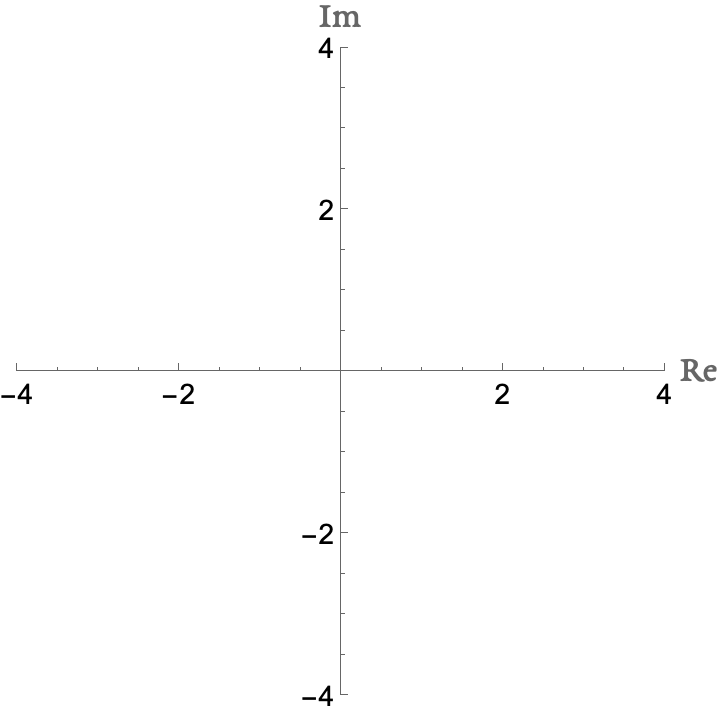
- Plot the roots of the characteristic polynomial of Equation 1 on the following set of axes. Then, determine if this system is stable or unstable and whether it is underdamped, overdamped, or critically damped.
- Write down the transfer function of this system, where \(F(s)\) is the input and \(X(s)\) is the output. Do not use any other expression for the transfer function of second-order systems that you may be aware of; deduce the transfer function directly from Equation 1.
- Find the unit step response of this system, and give your answer as a function of time.
- Find the unit impulse response of this system, and give your answer as a function of time.
- Make a quantitatively accurate sketch, by hand, of the Bode plot for this system, and draw vertical lines showing the corner frequencies.

- If the system is subjected to an input \(f(t) = \sin t\), determine a mathematical expression for the output \(x(t)\) after it has reached steady-state.